Burial Day Books is a boutique publisher of supernatural horror short stories. Once a month we feature an established or emerging horror writer. These short supernatural horror stories deal with elements of superstition, folklore or myth. We look for writers that are innovative but can also give a nod to past – classic horror. We feature scary stories with limited gore and limited extreme violence because of the belief that fear, true fear, comes from the unknown.
Hourglass by Colleen Anderson
Time
machine
forged of ice
frozen days gone
today boils away
strange mists of yet to be
combined circuitry and steel
Volta’s great gift the battery
excites offerings, babe or granny
variances from the range of our lives
ignore their screams as bodies crisp and char
dials spin a dervish dance tuning
somewhen, future or past perfect
utopia’s joy reigned/reigns?
a flash—children laughing
grandparents hold hands
results don’t lie
as you lose
all this
Time
==
Colleen Anderson poems have been published in such venues as Mirror Dance, Polu Texni, The Future Fire, HWA Poetry Showcase and others. She is a Canada Council and BC Arts Council grant recipient for writing and has performed her work before audiences in the US, UK and Canada. Colleen’s collection, I Dreamed a World, will be published in 2021. Colleen has also published fiction including the collection A Body of Work, Black Shuck Books. www.colleenanderson.wordpress.
Inviting Family for Breakfast by Anton Violazzi
Director’s Cut by R D Doan
Director’s Cut
by R D Doan
Monty could almost taste the blood that needed to be spilled. His skin crawled with anticipation, but he was trapped in his director’s seat filming yet another abhorrent take in what should be the last scene in his first feature film.
They’d reshot this scene at least a dozen times. Each take like the last. He found it difficult to focus on directing when all he could think about was scratching an itch he couldn’t scratch. He needed to do something soon or he might explode. He had to call it. He was sure he could salvage something from one of the takes. He just wanted to be done with this film and get on to what really mattered.
“That’s a wrap!” he called, eliciting cheers from the cast and crew. They were no doubt happy to be done filming as well. It had been a long three months.
“Gather round, gather round! Great work, everyone. Really. It was a pleasure to work with so many talented people on this. You’ve all made my transition from online films to the big screen look easier than it should have. It’s hard to believe that a year’s passed since first getting the opportunity to make this film. And let me tell you, it’s gonna be great, and I owe it all to you!”
There were more cheers in reply.
“Really, from the bottom of my heart, thank you,” Monty said, while locking eyes with a brunette a few rows deep in the crowd. “Thank you.”
#
As the crowd began to disperse, Monty looked for the brunette, whose hair was held in a bun with two metal hair sticks. He found her chatting with another young actress.
“Bridgett! Hey Bridgette! Hold on a sec,” Monty called, running to catch up with her.
She finished her conversation and turned her attention to Monty as he approached.
“Bridget. I’ve been meaning to talk to you.”
“Me?” she asked, looking a little surprised that he knew her name.
“Of course, you! Do you have a minute? Maybe we can go somewhere to talk.”
“Sure. I mean, like, now? Okay.”
Monty placed his arm around her shoulders and started to guide her off the set. He could tell she was feeling a little uncomfortable with his touch.
“Bridgette, I hope you don’t take this the wrong way, I mean, I think you did a wonderful job on this film; but, you have so much more potential! I think you did a great job in your role here, but, let me tell you, I’d just kill to have you in another project I’ve been working on.”
“Really Mr. Brinker?” she asked. Monty felt better as she seemed a little less creeped out, and more excited about being offered a role. “What kind of role is it?”
“Let’s just say you were made for this role. All I need to do is get you on film for a screen test, and we’ll be all set.”
Bridgette slowed her gait to a near halt. “I don’t know Mr. Brinker.” Monty sensed her trepidation. He could tell she was starting to think he was trying to seduce her. He didn’t want to scare her off.
Monty assured her, “Whoa. It’s not like that!” he laughed. “Honestly! Look, wait here. I’m going to go in my office here and get my camera. I’ll show you. We can even do it out here in the open if you’d feel more comfortable about it. I promise. I’m not here to do any creepy Weinstein shit. Scout’s honor!” He held up three fingers in a scout sign for effect.
Bridgette cast her gaze to her feet, then back to Monty. “Okay. Sorry, I didn’t mean to…”
“Bridgette. Don’t sweat it. I get it. Just, hold still. I’ll be right back. I promise.”
#
Monty wasn’t gone long. He returned carrying a small handheld tape recorder. It looked similar to the one his dad used when he shot family videos during his childhood. It recorded on cassette tapes rather than digital format. Monty wanted to get shots like his father before him; and what better way than with a camera like his?
“See?” Monty asked, showing her the recorder. “Now, how ‘bout I have you stand over there by the door…right there. Good.” He glanced around and saw that the last of the cast and crew had left. They were finally alone.
He looked at her through the viewfinder of the camera and said, “Not quite. How ‘bout you stand in the doorway; maybe rest your left hand on the doorframe?”
She backed awkwardly into the doorway and put her hand on the doorframe at shoulder level. “Like this?” she asked.
“Maybe higher up. Perfect,” Monty replied.
He again appraised his shot through the viewfinder and nodded in approval.
“Alright. We’re almost ready. One more thing. Let’s do something about your hair.”
He approached her and pulled the hair sticks out of her bun, spilling her hair to her shoulders.
“Looks better this way,” he said as he tucked her hair behind her ears. “Perfect.”
Monty leaned in to whisper into her ear, “I’m going to make you very famous, Bridgette.”
He stabbed her between the third and fourth rib with her hair stick, piercing the heart.
He pulled out and applied pressure to the wound, effectively trapping her blood in the lungs and pericardium around the heart.
She was speechless in her shock, and soon, as blood filled around her heart and lungs, she struggled to breath. She gaped at him in terror as she approached her death. He helped her to the floor when her legs weakened and positioned her back in a sleeping pose.
He raised the camera and pressed record. He wanted to record her pleading eyes as life escaped her.
“Smile, Bridgette. You’re famous!”
#
“The devil is in the details, Monty, and there isn’t enough devil in this horror film’s details!”
Monty was used to casting, shooting and editing on his own when he made his online horror flicks. He wasn’t used to sharing the task with an editing team; nor was he used to producers breathing down his neck injecting their opinions on the film’s direction.
“Why don’t you stick to negotiating with studio reps, and let me do what I do best,” Monty replied, annoyed by his producer’s constant interjections.
“Don’t get me wrong, man. I love this film! It just needs… I don’t know, more blood or… something. Your shit usually feels more real than this. It’s missing something.”
Monty rubbed his face and sighed. “I can only work with what I’ve got, David.”
“Your online stuff always felt so real. This just feels, I don’t know, forced? Fake?”
“What do you want me to do, David? We’re already over budget. Reshooting or recasting could bury this film!” Monty ran his hand through his hair.
“Are you sure you’ve gone through all the footage? You’ve got to have something somewhere that can fix this. I can’t take a loss on this, man. C’mon, think.”
“Maybe,” Monty was thinking of his pet project. If I only use a few of the girls. If I use footage from too many, someone might connect the dots. “Okay, so hear me out. There’s more film on a few of the death scenes, but it’s complicated.”
“Complicated how?”
“I have two scenes that I left out. I thought… I thought maybe they might be too sensitive in light of recent events, so I opted to keep them out of the film.”
“Bridgette and Anya.”
“Yeah.”
“I can see how including death scenes on two missing actresses can be in bad taste, but how do we know they aren’t on an exotic trip or some shit? Millenials do crazy shit like that all the time, don’t they? Whether they’re dead or alive, I don’t really care. What they do after they leave the set is their business. All I know is that this movie needs to be better. If those shots can help the film, I say we put them in. I’ll take whatever heat may come from it. You take care of making this film more realistic.”
Monty nodded. “Alright. Give me a few hours and I’ll show you what I got.”
“Make it better. You may not get another shot if you blow this movie, Monty. Two hours,” David walked out the door, already texting away on his phone.
“Two hours, man!” he yelled from the hall.
#
Monty unlocked a drawer under his desk. Inside were dozens of cassette tapes and his handheld camera. He could feel his pulse quicken and his mouth go dry. He had sworn to keep them locked away, to abstain from his urges. What had he done? How could he possibly watch the tapes and not want to act. After Bridgette, he’d been able to contain his desires. He swore she would be the last.
He could see flashes of each murder now that he was holding his camera again. The urge was rising. He wasn’t sure he could do this alone.
He picked up his cell and called the only number saved on his phone.
“Talk to me, man.”
“Brian…I need your help. I really want to use, and it’s right in front of me.”
“Alright Monty, take a deep breath. Let’s just talk.”
#
Monty would rather gouge out his left eye than give another interview, even if all they wanted to do was kiss his ass and tell him how great he is. He hoped his hiding spot was good enough to avoid more talking.
He sighed when he saw who had finally found him at the bar.
“I gotta hand it to ya man, you really pulled off some Houdini shit with those added scenes. I’ll be honest with ya. I didn’t think you could pull it off.”
“I wasn’t so sure I could pull it off myself, David,” Monty shrugged.
“Those shots were amazing! Much more realistic than the original cuts. Who knew those girls could act like that!”
“Yeah…who knew?” Monty turned to the bartender and asked for another champagne.
“How’d you get ‘em?”
“It was difficult. Let’s leave it at that.” Monty wanted to kill so bad after revisiting the tapes, but was able to refrain. “Lot’s of blood, sweat and tears, I guess.”
David’s phone rang and he excused himself, much to Monty’s relief.
#
He watched the partygoers with disgust. He despised their fake laughs and found it all to be exhausting. They were all useless if you asked him.
Then he saw a young lady standing alone by the wall. She kept checking her watch and glancing around the room. She appeared uncomfortable mingling among Hollywood’s elite. He could tell she was different from the others. He had to have her.
He checked his phone, meaning to call Brian, his sponsor. No service.
Her glass of champagne was low. It was now or never.
Fuck it, he thought. He took two fresh glasses from a waiter going by and walked toward her.
“Here. Have a fresh glass. It’ll calm the nerves.”
The girl looked up and appeared startled. She put up a hand. “I don’t know. I mean, like, what if there’s a drug in it or something? You seem like a nice guy, but, no, I’m good. Thanks anyway.”
“Oh, come on. I just grabbed it from that waiter handing them out over there. I’m not a rapist. I promise. I see myself as more of a serial killer if you really must know,” Monty replied with a shrug and smirk.
“Right. Okay,” she conceded and took the champagne. “If you’re going to kill me though, do it quick. This party might kill me first.”
“Not a fan of premiere parties?”
“Is it that obvious?”
“Not my thing either, but I kinda have to be here. So, I know you weren’t in the film; what brings you to the party?”
“My friend’s brother. He’s in the movie. I guess he just needed a pretty girl on his arm for the red carpet. You know, so he doesn’t look gay or something.” She took a big swig of champagne and sighed. “But after a few drinks, he kinda makes it a little obvious, don’t you think?” She pointed to a guy who kept touching the chest of another guy while laughing at what must have been the funniest thing he’d ever heard.
“Well, his loss is my gain.” Monty clinked glasses and took a sip. “What did you think of the film?”
“It was good, I mean, I don’t usually see films like that, but I really enjoyed it,” she said fidgeting with her handbag.
“What do you usually like to watch?”
“Mystery, crime thrillers, I guess? Have you seen Knives Out yet?”
“No. I’ve heard it’s really good though. It got really good reviews on Rotten Tomatoes. Did you see it in a theater?”
“No, but the person I stay with was talking about it too. And then I was describing it, and he was like, ‘You went?’ and I said, ‘No, somebody told me about it,’” she looked away, avoiding eye contact. “I haven’t seen it yet.”
“You should see it. There’s a director’s viewing room here. The chairs are so nice. I love the butt warmers. They keep you nice and toasty. I’m sure I could find the film. We should get out of here and go see it,” Monty raised his glass. “My treat.”
“That’d be awesome! We should totally go do that!” A smile slowly crept across her face. “But, how are we gonna get in?”
“You just have to know the director.”
Monty took her glass and set both of their drinks on a nearby table. He took her hand and started to walk her across the room to a side door that lead to an elevator.
“You know the director?” she asked in amazement.
“Sweetheart, I am the director.” He said as he guided her through the doorway. “You’ll just die when you see the viewing room.”
#
Monty opened the door to the viewing room and flipped on the lights.
“Oh wow! It looks like a little movie theater!”
“Yup. Butt warmers and all.” Monty was unlocking another door at the back of the room.
“What’s in there?”
“This is the editing room. Should be drinks in the mini fridge. You want something?”
“Sure.”
Together, they entered the editing room. Monty went to the fridge and tossed her a beer.
The young woman began to slowly examine the components, cameras and computers. “This stuff looks pretty complicated. Do you ever use real film anymore? Or is it all digital now?” she asked, sipping her beer.
“Mostly digital, but I have a few projects I do in film still.”
She continued to snoop as Monty stepped out to set up the movie in the viewing room. The drawer under the desk had not been closed all the way. She opened it, pulled a cassette tape out and popped it into the handheld camera that was also in the drawer. She covered her mouth and gasped in horror as she watched a brutal murder unfold.
Monty had the movie set and ready to go. He glanced around the viewing room and visualized the young woman’s death scene. He envisioned her laid out in a viewing chair, choked from behind to avoid bloodshed. He’d have her face the film playing in the background. He’d call the scene: “Dying to Watch.”
His heart raced in anticipation. He needed his camera. He needed her out of the editing room. He began to wonder why she was still in there.
Monty stopped in the doorway. “Movie’s almost ready. Come pick a seat.”
The young woman was leaning back against the counter and looked nervous.
“Why don’t you come over here first?” she asked, raising an eyebrow and smirking.
Whatever gets you to leave the room, lady, he thought.
He slowly approached her.
She had a nervous energy about her that Monty mistook for sexual tension.
He leaned in with the intent to kiss her and noticed his camera out of the corner of his eye. It was on the floor at her feet. He was about say something when she grabbed his hair and he felt a sharp, cold sensation in the back of his neck. The pain and brightness derailed his thoughts. His knees buckled and he collapsed to the floor.
The young woman trembled as she pulled a pair of scissors out of the wound she made in the back of his neck. She had stabbed him with the scissors at the base of the skull, severing his spinal cord. He was still alive but paralyzed from the neck down. He’d be dead in a matter of minutes.
She ran from the room and screamed for help.
As he lay on the floor, unable to move, he prayed the camera lying nearby was filming. Capturing death as it left a body was pure ecstasy. He wanted nothing more than to feel invincible one last time.
His vision began to tunnel as he noticed the red light on the camera wasn’t on. His final thought was of disappointment. Disappointment that his own death hadn’t made the final cut.
==
R D Doan, a member of the Great Lakes Association of Horror Writers, most recently has had short stories appear in The Sirens Call eZine, the GLAHW anthology Marisa’s Recurring Nightmares and in the anthology, Nobody Goes Out Anymore: Futuristic Fiction Post Covid-19. As a Physician Assistant, he’s written numerous academic articles, but prefers to wade into the waters of darker fiction. He resides in West Michigan with his wife, two sons and dogs.
He can be found online on Twitter (@rd3_pac) and Instagram (@rddoan).
Fatsy Noodles by Robert Kostanczuk
Fatsy Noodles
by Robert Kostanczuk
And so it came to be that Nan and Kix ended up at the godforsaken Destree barn.
The descent into night, the whipping rain and their frantic plight had brought them there.
As the thunder roared and rumbled outside, the partners in crime caught their breath and gathered their senses amid the sounds of rats scurrying through the hay and across patches of grain strewn across the dank Kentucky dirt.
Nan and Kix had just stolen a car.
Neither had been in any serious trouble with the law before, but crystal meth and deadly youthful boredom fueled this particularly reckless criminal escapade.
In a wave of panic, they ditched the beater vehicle in a marshy thicket that was pretty far from home.
That made for a fairly long journey by foot.
But rationality of thought was not in the cards on this volatile day.
While trekking back to their hometown, Nan and Kix had stumbled upon the deserted Destree farm, which was just a quarter mile from where they eased the swiped car into a swampy area.
The barn provided necessary shelter from a volcanic storm that worsened an already tense situation resulting from the ill-advised car heist.
“That joyride wasn’t worth it,” Kix said, shaking his head in disgust.
“Yeah, tell me about it — what a waste,” Nan concurred, trying to catch her breath. “We got a long walk back.”
Kix peeled blobs of mud off the bottom of his boots.
“Ya think anyone saw us take it?” he asked his girlfriend, bracing for a reply he didn’t want to hear.
“I don’t know, but I don’t think so,” came the best-case-scenario response.
The heavy oaken barn door that Nan and Kix had closed behind them was not staying shut in the heavy wind, which slammed it open and shut on an all-too frequent basis.
It was unsettling to the pair, who were also subjected to the unnerving sound of creaking wood that radiated from all corners of the old structure.
Sitting on a bench near the entrance, Nan and Kix huddled together, waiting for the storm to break so they could trudge back to town, and out of the mounting nightmare encompassing them.
Twilight was quickly plunging into nocturnal shackles.
“I can’t wait to get out of this hellhole,” said Kix, looking around at the sporadic lightning that lit up cracks and holes in worn walls surrounding him.
“There’s something truly weird about this place,” Nan whispered, although not quite sure why she felt the need to whisper.
She stole a sidelong glance at Kix, to see how he was holding up.
He had only two previous run-ins with police; one for disorderly conduct at a football game, and one for underage drinking at a friend’s party. Nan boasted a clean slate; she was just along with Kix for the ride, latching on to his rebellious nature, which she found invigorating in her stale, rustic life.
“It’s all gonna be all right,” she said while playfully ruffling up his wet, matted head of hair.
“I know it will,” Nan concurred.
Although beginning to feel chilled by her wet clothes, Nan was physically warmed up by her boyfriend‘s self-assured demeanor.
The sense of well-being slipped back into a state of unease as soft thuds were heard.
The hayloft appeared to be the source, and the sound increasingly resembled methodical footsteps.
Looking up, Kix and Nan couldn’t help but think they were not alone.
Remaining perfectly still for a few seconds, both were hoping it was merely Mother Nature rocking the rickety, light-starved barn, and stirring up noises.
“It’s nothing, I think,” Kix said quietly.
However, increasingly loud gurgling began wafting through the air from the upper reaches of mammoth, but rotting, overhead beams.
The teens were hearing something akin to a rippling, muddy stream. Nan wondered if it was water rushing into the barn, but the noise was coming from up above.
Kix had enough of the unwelcoming Destree property: “Looks like the weather’s let up; better get while the gettin’ is good. I never thought I’d make it onto this land. It’s as messed up as everyone said it was.”
Just before stepping outside, Nan caught sight of a slight glistening in a rear corner, near horse pens.
Swinging open the barn door for more light, Nan walked toward the glint.
A smile of recognition soon stretched across her face.
“It’s true; the Destree calliope really does exist,” Nan said with an air of wonderment.
Its columns of whistles draped in cobwebs, the wagon-mounted calliope was glazed in dull circus colors of gold, scarlet and purple.
Peering more closely, Nan honed in on the wooden housing that encased the calliope, except for sizable, oval openings on two sides of the wagon, through which the worn whistles could be seen.
Jesters, with menacing smiles, were carved at the borders of the openings.
“Let’s get out of here before it starts playing by itself,” Kix said a tinge of urgency.
Slipping onto the soggy ground of the abandoned acreage, Kix and Nan began to walk back home down Old Moon Road in the heavy humid air that replaced the rain.
Faint at first, a sour and discordant melody trailed from the rear.
As Kix and Nan moved further away from the Destree property, the mournful, dirge-like tones of the calliope grew in intensity.
Remnants of the roiled weather shot out muffled blasts of electricity in the dense, purplish heavens.
“Who’s playing that contraption? No one’s lived on the Destree farm for years,” Nan said with a perplexed shake of the head.
She and Kix sped up their walking as the calliope’s devilish presence faded with each forward step.
Home — and respite from the stolen-car fiasco — was about three miles ahead.
The roads leading there were winding, rural, and largely unlit.
Bottomland hardwood forests lined them.
“Maybe we shouldn’t have panicked; we could’ve just taken the car back instead of ditching it,” Kix said during the walk in darkness.
“It’s water under the bridge; it’s over, we’ll be OK,” offered Nan, genuinely believing that the worst was over.
She then looked behind her, out of boredom.
She thought she saw a shape — a stocky shape — silhouetted against the still agitated skies.
It was pretty far in the distance. It was rather small, and human shaped.
Nan turned back toward the front, hoping the vision would just disappear.
Peering to the rear again, Nan found that her perception was not illusionary.
Something was skittering along the high weeds and dense brush at the side of the road, and picking up speed.
Trying not to alarm Kix, Nan slowly swiveled her head to the front.
A few seconds later, she methodically looked back.
It was closer.
This time, she snapped her gaze ahead of her.
Letting a full minute pass, she warily turned her sights toward the rear again.
It was gone.
“What you lookin’ at?” Kix said, looking back himself and seeing nothing.
“I thought I saw something; it’s no big deal. Let’s stop at this convenience store. I’m dying of thirst. I need some water.”
The Take-A-Break was a figurative beacon of light for Nan — a return to normalcy at such a tumultuous time.
The boxy, ramshackle outpost glowed at an otherwise unlit four-way stop at Old Moon Road and Oakwood.
Everyday things could be bought at Take-A-Break. Pop, chips, Red Bull, warmed-over pizza slices sitting under a cheap heat lamp … it all felt like regular living to Nan. It was what she yearned for now.
Inside, a wiry, disheveled cashier eyed Nan and Kix as they got a couple bottles of water and brought it to the checkout counter.
“Will this be it?” asked the worker.
“Yep,” Kix said, digging money out of his jeans.
“You guys look like you’ve been through a lot tonight; you’re kinda wet and dirty,” the cashier said while taking the dollar bills.
Nan proceeded to tell him much more than she really wanted to, relating how they had got caught in a storm while out for a long walk, and were forced to take cover in a dirty barn along the side of a road.
“Oh, you must be talking about the ol’ Destree farm,” said the worker, his eyes lighting up in recognition. “By the way, they call me Slick the Stickman, ’cause I’m pretty resourceful, and tall and skinny.”
A smile stretched across Slick’s weathered face that was peppered with the beginnings of a silver and black beard.
His eyes danced with energy, while the auto-mechanic jumpsuit he donned spoke of everyman relatability.
Because it was on an outskirts of town where there was little but agricultural activity, Take-A-Break had been a sporadic stop in the past for Nan and Kix, so they were unfamiliar with the colorful Slick.
Before they could begin to pay for the water, the pair took in some history of the Destree land, courtesy of a talkative Slick.
“An odd, twisted little girl once lived there,” he said while aimlessly running his hand through his thick, greasy and flowing locks of hair.
“Her name was Madison, but she was known as Madsy,” Slick continued. “Over time, that turned into Fatsy. Actually, the mean kids had a complete name for her: Fatsy Noodles.
Nan giggled.
“Actually, she wasn’t very funny,” Slick quickly shot back in a corrective, but patient, tone. “Fatsy Noodles was, in truth, pretty creepy. And probably pretty deadly.”
Slick, who had been standing, pulled up a stool, and sat down, and settled in behind the counter.
* * *
“Fatsy was always different, even when she was just 4, 5. But when she hit 14, 15 — she hit her stride, let’s put it that way,” Slick smiled slyly.
He went on to weave the story.
Nan and Kix sat down on a couple of stacks of 24-can cases of Coke.
They heard Slick explain that Fatsy never was really fat, just “big boned” and maybe a bit more muscular than girls her age around the county.
“I think you could call her a fireplug; ya know, a bit short and stocky. They say she was just 5 feet and 1 inch when she left high school, and sort of went into seclusion and became just a mysterious living thing.”
Madsy Destree really only left her family farm to do harm, Slick related.
As the legend went, she particularly enjoyed exacting revenge on those who had taunted her in elementary school and high school.
“Picture this,” Slick urged, making sure he kept eye contact with his small, captive audience.
The descriptive narrative unraveled as if it were being told around a campfire, in the moonless gloom, on Halloween.
The only child of Clemson and Gertrude Destree was always an outsider; a loner.
She wore her pigtails thick and full, draping them over the front of her shoulders.
Madsy kept to herself; didn’t have many friends.
“Her first childhood friend became a turncoat; Melissa Gyner saddled her with the reputation of being heavy,” Slick related. “Melissa even made up a rhyme: ‘Fatsy Noodles ate some poodles.’ That was around when she and Madsy were both in first or second grade.”
Nan repeated the quirky name: “Fatsy Noodles — sounds like a dumb cartoon.”
Slick had a quick retort: “She sure was no comic. Fatsy didn’t just idly by and let people dump on her.”
Melissa paid the price with ravaging puncture marks, one on the top of her right forearm, the other on the underside, Kix and Nan were told.
“The wounds got infected; Melissa almost lost her arm,” said Slick, taking a bite of an apple, then putting it down.
“Ya ever see an alligator snapping turtle?” Slick asked.
“Don’t think so,” Kix replied.
“Nope,” Nan answered definitively.
Slick detailed how that kind of turtle basically has “a one-fanged upper jaw and a one-fanged lower jaw that snaps and pierces.”
He added that, as the story goes, Fatsy had a tightly drawn, and compacted mouth that was able to violently spring open into a gaping, gruesome yowl.
“She was supernatural; that’s the only way to explain it. She’s a ghost, and ghosts apparently can bite, can’t they?”
Nan and Kix looked at each other, and smirked.
“Maybe she could bite, but she also sucked,” Kix chortled.
Slick dismissed the mockery, deciding, instead, to proceed.
“As long as you’re laughing, you’d probably laugh at the fact that Fatsy kinda waddled when she walked,” he related. “But when you saw that bizarre walk heading for you, it wasn’t so funny. She really was an it, not human — something demonic.”
Slick felt it was time to summarize the saga and wrap things up.
“Fatsy disappeared about 75 years ago. She left the farm as a young adult, and never returned. There were newspaper articles that she made it out to the West Coast, that she was seen walking out into heavy surf on some California beach, and was never seen again. Authorities reported it was a stormy, turbulent day. It’s assumed she drowned. Her body was never found. She might have died in her late teens or early 20s. Who knows?”
Nan couldn’t help but wonder just how “supernatural” this Fatsy really was.
“So, how many people did she bite?”
Slick chuckled.
“Well, legend has it she bit quite a few, and sometime gargled with their blood. It’s not only about how much she bit, but who she killed.”
Leaning toward Nan and Kix, Slick whispered his next sentence for dramatic effect: “You see, there’s pretty strong evidence she murdered two, three — maybe five six people, including a couple of drifters who wandered into this sleepy, forgotten corner of Kentucky.”
Nan was sucked into vortex of rural folklore that spun with wild allure and endless questions.
“Why the murders? Why the killing?”
Slick explained the slayings were always about retribution for perceived personal harm.
“She’d follow; she’d stalk; she’d get her man — or woman, or boy, or girl — whatever the case might be. She’d appear out of nowhere; striding forcefully toward her victim; pigtails pressed against the front of her shabby dress; mouth slowly opening … then, agape.
“If people looked at her the wrong way because of the way she looked, Fatsy would exact revenge. There’s a story about her tracking down and killing an old woman who kept staring at her in a grocery store. The woman’s body was found with bite marks — punctures — all over her face.”
For the slightest moment, Nan considered the possibility that it was Fatsy who trailed her and Kix on the way to Take-A-Break.
But the surreal yarn which the convenience worker spun seemed such a fantasy, that it actually put her mind at ease about there being any chance the demon girl was, indeed, the follower.
She and Kix grabbed their bottled water and began walking out of the Take-A-Break, heading back to Old Moon Road.
“Thanks for the tale; it’s interesting,” said Kix, giving a flick of his hand to wave goodbye.
“I think it’s more than just a tale,” Slick grinned.
* * *
Out in the dense, muggy atmosphere again, Nan and Kix quickly gulped their water and tossed the bottles away.
Refueled, they both discussed how this horrid little episode which entangled them, was about to end.
Home was just a mile away.
Immediately to the left, the fairy-tale residence of Widow Kyefsky rose above them, outlined against vibrantly endless and cosmic skies.
An ornate mishmash of Queen Anne and Victorian architecture, the mansion fit the otherworldly leanings of Lady Kyefsky, who was strongly rumored to be a witch.
She was standing out front, at the beginning of her winding walkway, which cut through a massive wild garden of overgrown grass, burgeoning bushes, fiery flowers and assorted vegetation.
She waved at Nan and Kix to come near.
They didn’t want to, knowing her reputation among the locals as a crazy eccentric.
For the flash of a second, Kix considered tugging Nan’s arm and leading her to the other side of the road.
But he opted to gut it out and directly pass by her.
“Come! Hurry! You’ve been followed here. Get off the road!” Kyefsky prattled, while simultaneously motioning for the two youths to move up the passageway leading to her home.
“Who’s following us?” Nan asked incredulously, conveying a hint of fear.
“Something ungodly. Something dangerous,” came the response.
Kyefsky ushered Nan and Kix along by successively placing her hand on the right shoulder of each, and then firmly steering them up the uneven stone path.
They moved, she followed behind, giving gentle nudges to the small of their backs to provide them with a sense of urgency.
Kix found himself inexorably following the old woman’s directive, as did Nan.
Neither knew exactly why they were so compliant.
As she was hurriedly prodded along toward the looming, arched doorway of Kyefsky’s house, Nan wondered to herself if this creepy lady did, indeed, have mind-controlling capabilities.
“How do you know we were being followed?” asked Nan, not looking back in the direction of Kyefsky.
The answer to the question came with firm assuredness: “I have certain powers, dear. And I very much know this thing that is after you.”
Swinging open her heavy, oaken front door, Kyefsky led her two charges inside to a foyer where crimson stained-glass windows loomed up above.
Taking a quick look outside before closing the entrance, she made a pronouncement with a discernible air of relief: “No sign of the ghoul.”
Nan had the overwhelming sensation of being locked in; shut off from the outside world.
It was so quick, she didn’t know how it happened.
Kyefsky ushered her visitors to a side parlor. The room was dimly lit, with clutter that included old books, herbs in bottles and burning candles.
“Fatsy Noodles is after you. She is angry. You invaded her space at the barn; I know all this because I have the help of that,” said Kyefsky, pointing to a crystal ball on a rough-hewn wooden table.
“Sorry, lady, I don’t know you,” Kix said in a hybrid tone of annoyance and fright.
Kyefsky grew silent for a few seconds, curiously looking over the two disheveled young people, as if assessing exactly what kind of naïve innocents she had standing before her.
“Believe what you like. You can stay with me for safety or go back out there. You decide.”
The ultimatum resonated with Nan.
She was in no mood to venture outside, just yet.
Besides, it could be fun checking out the spooky old house, she thought.
“Come up to my little nook; it’s safe there, follow me,” said Kyefsky, sensing the youths were acquiescing.
Kix just smiled in bewilderment. The situation was reeling in Nan and him.
Kyefsky guided the pair to a wooden, spiral staircase with large knots in the surface of the wooden boards.
She informed them the twisting steps led up to one of the two turrets in her home.
She tried to stay calm and orderly, but wore down and spoke with urgency: “Come, hurry, climb the steps.”
Kix and Nan followed Kyefsky up to the turret as their footsteps made the staircase creak and crackle with shards of sound.
The witchy woman spoke before opening the door to their place of refuge.
“The car you stole belongs to a distant relative of Fatsy’s. The bloodline definitely is connected. She doesn’t like that you stole the car. She doesn’t like you were in her barn.”
Kix and Nan were jolted by Widow Kyefsky’s knowledge of the swiped vehicle.
“You might be right about the car; I’m not saying you are. But how do you know about it?” Kix said with piercing curiosity.
“I have powers,” Kyefsky said, as she swung open the turret door in front of her.
Kix needed to crouch down a bit to enter through the low doorway.
Inside the cylindrical room, he and Nan quickly took stock of their surroundings.
Windows surrounded all sides of the lofty space, which burned with the soft glow of evenly spaced candles lining the circular wall.
Walking along sturdy oak floorboards to the front of the turret, Kix and Nan gazed down, and saw a car parked in the street.
It was situated so that its headlights — its bright beams — blazed directly toward the front door and up the walkway.
Though it was difficult see details of the vehicle, Nan believed there was caked-on mud along the bottom edges.
She felt she was looking at the well-traveled, four-door Buick sedan from the 1990s that Kix and her had swiped and dumped in the mucky bottomland hardwood forest, rimmed with cypress trees.
“That’s the car we stole,” she whispered to her mate.
Kix merely stared in stunned confusion at the vehicle.
Then, he spoke: “I don’t know what’s goin’ on here.”
Kyefsky had descended the staircase while Kix and Nan were distracted by the bizarre sight in the world below the windows.
Rustling, commotion then wafted up through the open door of their lofty room.
“Let me go!” came a scream from down below.
It was Kyefsky.
Fatsy’s bite had dug into Kyefsky’s left arm at the foot of the staircase.
“Oh, it hurts! Oh, it hurts!” she whimpered with chilling emotion.
Kix and Nan shuddered at the wailing that reverberated up to them.
Peering down to the bottom of the stairwell, they watched a shadowy figure slowly ascending.
Then it became clear to the pair that it was a dazed Kyefsky making her way up.
She used her right hand to painstakingly pull herself along.
When she finally stood before Kix and Nan, Kyefsky rolled up the left sleeve of her billowy blouse to reveal ugly wounds.
The top of her forearm had a puncture wound that oozed blood.
On the exact opposite side of her arm was another puncture wound that also bled, on the underside.
“Who … what bites like that?” Kix blurted in dizzying wonderment.
“She bites like an animal … she may still be my house! I don’t know where she is!” Kyefsky cried. “I fought her off. I fought her off. But I don’t think she wanted to kill me. She could have killed me if she wanted to.”
The words were delivered breathlessly, but with clarity and an increasing sense of composure.
For a few seconds, Kyefsky stood silently with Kix and Nan in an attempt to hear any noises or movements that would indicate the stalker was still present down below.
There was one slight bumping sound, followed by what resembled faint shuffling along the floor.
Kix finally spoke … in a whisper.
“Why should we be afraid of her? Does she have some sort of super power?”
Kyefsky, who was calming down, answered.
“I don’t know if she’s from another world. All I know is that she’s not right — and is terrifying.”
The need to get Kyefsky to a hospital for her bite wound forced the trio-in-hiding to venture down the stairs.
Kix led the way, mentally stoking his bravado in the event he had to punch the ungodly thing.
At the foot of the stairs, the trio stopped and scanned the darkened home.
A grandfather clock along a hallway ticked with a mesmerizing cadence.
There was no sign of the attacker.
Slowly, the three comrades made their way to the front of the house to see if the stolen car was still out front.
On the way, a shuffling noise was heard in a hallway closet which had its door slightly ajar.
Nan began to walk backwards.
Her senses were on high alert. Acute focus came into play like never before.
A flash of black darted from the closet, along the floor.
“Pluto!” Kyefsky blurted with a sense of relief.
It was her cat.
Kix and Nan laughed at the absurdity of the surreal situation engulfing them.
The low hum of a running car engine then seeped into Nan’s awareness.
It was the stolen Buick, still pointed at the house, but this time the headlights were off.
No one appeared to be inside.
“The keys must be in the car; I have an idea,” she told Kix.
Her plan was to hop in the car and return it to the house where it was stolen — leave it parked on the street in front of the residence, and then run like hell.
“Let’s make amends,” Nan said, squeezing her boyfriend’s arm for emotional support.
“OK,” Kix confirmed. “That works. I just want to make sure that freak isn’t in the car, or around it.”
As Kix and Nan edged toward the vehicle, Kyefsky went to the bathroom and wrapped her wounded arm in gauze, with plans to drive herself to the hospital.
She had always prided herself in being self-sufficient.
The bizarre and rattling experiences which had just descended would not force her to deviate from that characteristic.
“You guys gonna be OK going home?” she asked her unexpected visitors after emerging from the bathroom with her wounded armed covered.
“Yeah, we’re leaving. We might take that car — or we’ll walk. Just depends,” Kix answered.
Kyefsky headed to the rear of her home, where the garage stood.
She never made it.
A crushing bite to the neck sent her into shock, and brought death almost immediately as blood gushed on the rain-soaked grass.
At the same time, Kix and Nan peered into the Buick from a cautious distance away.
Then, they methodically walked around the vehicle to see if anyone — or anything — was in hiding.
All seemed quiet.
“I don’t know about getting in,” Kix said as he shook his head with uncertainty.
“It’s now or never,” shot back Nan, opening the passenger-side door.
Inspired by his girlfriend’s moxie, Kix jumped into the driver’s seat.
He immediately noticed the car’s charged atmosphere.
It emitted a crackle, a heightened air.
Sitting still for a few seconds to survey the surroundings, Kix and Nan realized this was make-or-break time.
Then, Kix placed the car in drive and headed down Old Moon Road.
* * *
“Man, I will never forget this night,” said Nan, peering straight ahead into the humid, hazy darkness.
Kix merely smirked at the pure nuttiness of it all.
“I just wanna drop this sucker off, and right a wrong, and get on with our lives again — in a normal way,” he intoned, giving Nan’s left knee a loving squeeze.
Kix wasn’t so sure his frame of mind would ever be totally returned to its original, carefree state, but he believed in the joint power of Nan and himself to weather any storm.
Nearing the ramshackle home from where the car was stolen, Kix noticed no lights were on in the house.
That was a good sign. It was late; the folks there must be in bed, Kix thought to himself.
With only a lone, corner streetlight providing sparse light down the block, Kix pulled the Buick up at the curb in front of the house.
Kix and Nan deftly and quietly closed the car doors.
They inched away, looking back at the vehicle just once.
Unbeknownst to them, a child was watching their arrival and departure from a front, anterior window of an adjoining house.
Berenice gazed with innocent curiosity as Kix and Nan, hand-in-hand, ambled away, while the trunk of the Buick Skylark lifted open ever so slowly.
A small figure crawled out of the trunk.
Totally catching the attention of the 8-year-old Berenice, the youngster plopped the chocolate ice cream cone she was eating on the window sill.
She normally wouldn’t have been up so late, but her birthday celebration had been extended by several hours.
Wiping her sticky hands on her pajamas, Berenice looked on as the mysterious being carefully rearranged pigtails.
They were moved from her back to the front of her bib overalls.
Berenice then saw a silhouette of the visitor with mouth agape.
Next came methodical movement as the presence in front of Berenice started to take steps, following Kix and Nan.
The steps gradually quickened.
Berenice giggled; whoever she was watching managed to put on a little show by ambling along like a duck.
==
Robert Kostanczuk is a former full-time entertainment/features reporter for the Post-Tribune daily newspaper of northwest Indiana.
He won first place for “Best Personality Profile” in a 1992 competition sponsored by the Society of Professional Journalists, Indianapolis chapter.
His fiction piece “Safe Haven for Nathan” was published in “Homicide Lullabies: A Collection of Adult Horror Stories” (2016: Severance Publications Ltd.).
Robert’s horror-themed “I Eat Anything” was included in “Shocking Stories” (2018), a collection from Rainfall Publishing Company of the United Kingdom.
His short story “Frozen Burial” was published in 2019 by The Horror Zine, a print — and online — magazine.
Also in 2019, his beastly yarn, “A Stirring in the Woodland,” was published by Schlock! Webzine of the United Kingdom.
Robert’s “Lizzie Borden Versus Belle Gunness” appeared in the Spring 2020 issue of Suspense Magazine.
Robert lives in Crown Point, Indiana.
Before the Gingerbread Stales by Matt Athanasiou
Before the Gingerbread Stales
by Matt Athanasiou
The gingerbread man cooled on a wax sheet. Georgia’s thumb skimmed over the scissors she had cut wrapping paper with. A snip-snip, and tlick-tlick would go the little man’s arms and legs on the tabletop—but it was just gingerbread, of no harm to her like real men. She reached for the frosting instead.
Yellow hair, green sweater, tan pants, chocolate chip eyes, red hot candies for a smile and, pinched between her fingers, Georgia snugged a candy heart into the gingerbread man’s shirt. She hoped the historical article in that Christmas Wishes catalogue was right, about English women eating gingerbread men for luck in finding a loving man—a man who never borrowed Georgia’s car without asking, who never slept with her friends. Santa failed every year to bring her a gentleman so sweet he smelled of cooked sugar, his skin honey-glazed, breath peppermint, tongue vanilla, a man she could call delectable.
She kissed her fingertip, tapped it to the candy heart—an extra touch of tenderness couldn’t hurt her chances—before devouring the cookie.
It took a week to meet her gentleman, although his hair was thin, more brown than golden, and his sweaters, pilled and baggy, were thrift-shop compared to the gingerbread man’s. Still, she would discover that he had a heart; she baked it in the oven the following week.
The afternoon they met was pleasant enough. The metro station was crowded, and she caught him with his hand in her purse. She cinched the bag’s straps around his wrist. First thought: struggle, scream for help, and shove him in front of an oncoming train. Second thought: lucky her. They shared smiles, and then a plate of fries at Sweet’s Salty Diner on his, Max’s, dime; he was a pickpocket but proficient, he claimed. Everyone had faults, and Georgia and Max were making do with what they had.
She bailed him out of jail the next night. He had been caught in the same station, only the officer didn’t ask him out for dinner. Max repaid Georgia, a chivalrous act, but went home sullen afterwards. He’d be fine tomorrow, she thought and imagined handcuffing herself to him.
On the third day, he didn’t appreciate her request to avoid stealing from that station; it was where they met, should be special to them, she insisted. He argued she would soon tell him not to filch from other women’s purses, to change altogether. With chapped lips like chewed red hot candies, he spat red hot curses at her about piggish cheeks, broad thighs, cloudy eyes. She shut him up with a kiss. In bed, he repeatedly told her to stop biting. She was nibbling to find his sweet core.
Evenings passed with calls unanswered. She worried another woman had stolen him away; she envisioned stabbing the woman and forcing Max to watch the hussy’s bitterness hemorrhage. But on a snowy dusk, he arrived at her door with a bloodied forehead. His chocolate eyes were lost in swollen, bruised flesh. She massaged his calloused hands, stared at those hardened, discolored knuckles. No questions were asked as she walked him to the bedroom.
Naughty had been his word to describe the bronze Christmas lights she tied him to the bed with. A not-very-nice name had been his word to describe her waving the ice pick and scissors, her making do with what she had. The sweetness inside of him was spoiling, and she yearned for a saccharine taste before he staled.
==
Matt Athanasiou’s writing has received honorable mention in the Writers of the Future Contest, and has appeared in publications such as Remastered Words, Flame Tree Press, and Gallows Hill Magazine. Find more of his work at mattathanasiou.com.
Tick Tock Goes the Clock by Lisa Brand
Tick Tock Goes the Clock
by Lisa Brand
Every passing day I notice my eyes drifting to the clock. I want it to be another hour, another day, just not the time it is now. Humans are impatient like that, I suppose. We wish to control time. We all have wanted to control time at some point in our lives. Whether it is to change the past to remove an embarrassing moment or to perhaps just to make more time for other people, we want to control it, but we can’t control what we’ve created. It runs everyone’s lives and we can’t do a single thing about it. Ironic, it seems that one of man’s greatest inventions is now something entirely above us, controlling all of us. It tells you when to get out of bed, go to work, time has even set boundaries on when we can and can’t do certain things. Like maybe I want to eat some pizza in the morning, why is it frowned upon? It’s scary, and you can’t fight back or try to rebel in anyway. For even if you do fight it, you’ll fall behind in your own future because time waits for no one here. You just have to live with it.
Now, I know time isn’t alive. That’s preposterous thinking if I thought otherwise. And if I am allowed to be honest, I wouldn’t mind this immortal idea controlling every second of my life. I would really just love to go with the flow and motion of time like everyone else. I just don’t understand why it has to make that god damn noise. It’s so loud and it makes it difficult to think. Why why why, does it have to be like this, what did I do to deserve this harsh, unbearable noise! It is constant, and has been going on for months. I do not know the exact moment where it started, but all I know is that it will not stop, and it is only getting louder. I’m always paranoid. The only time I’m able to sleep now is when my brain forces me to pass out, due to the exhaustion of not sleeping for days.
Every passing day I live, I am controlled by the sound of the clock. I hear it almost every second of everyday; it’s running my life. At school, home, almost everywhere I go. Time is my greatest fear, and I just continue to let rule over me. But why why why! I would have been more open to it, more understanding, if it didn’t have that noise; that dreaded tick tock tick tock! It comes from the clocks, all of them. I leave one room to escape it and yet another one is always there to take its place. It drives me insane. I don’t know how I live through it. It has been months, it mocks me and I just want it to shut up. I don’t know how much longer I can live through it.
The months go by, but it just seems to be getting louder. It is messing with my thoughts. There are some days where all I can do is sit and listen to what the ticking is telling me to do. It sounds crazy, I know, I know, but I don’t know how else to describe it. The ticks, the rhythm, it forms words and I know not to listen to it but, I just want it to stop, please let it stop. My mind is trying to keep me in the right, but I can’t understand it, time takes over everything I do. Right now I sit in my room, I try to ignore the ticking, and I try to focus on the things in my room. The soft curtains over the bedroom window, the sheets beneath me that keep me warm. There is also the lamp, turned off for now as I am suppose to be asleep. My eyes fall upon a pocket knife, and I cannot seem to look away. Honestly, it is a beautiful design, the brand has long been warned away, but the blade itself is still good. It is still sharp, the blade cold. I pick it up and let the dull side of the blade slide through my fingers. It is a very, relaxing moment for me, but then I hear it again.
The ticking
Taking over my thoughts
Tick tock
My world.
Tick tock
Everything.
I instantly look over to the clock sitting on the bedside table. That evil clock, I am not going to let it control me like this anymore. I get off of my bed and stand over it, this is the end. I pick it up, taking a second to listen to the ticking before slamming it into the ground over and over again until it was completely destroyed. But time will never die. It is the immortal creature of the universe. I continue to look at the broken clock and can’t help but sigh. You can never beat time, it is just there, never to leave. Putting the knife in my pocket, I walk into my living room and look to my parents watching the television. Amazing, how can they not hear it? The clock is right above the television! It’s so loud, louder than the T.V. And they are just sitting there like nothing is happening!
Tick. Tock. Tick. Tock.
I quickly move to the clock, grabbing it off the wall.
Tick. Tock. Tick. Tock.
A large crash, a loud scream, but the ticking is still louder!
Tick. Tock. Tick. Tock.
Then silence.
The ticking had stopped when the last thud was heard on the ground. Finally free from that dreadful noise, I sit on the couch and watch the television. Blood starts seeping in my clothing and I can only smile at the warmth of it, it feels so nice. The misery and insanity that was slowly taking over me is now gone, and I find myself laughing in relief. I don’t remember the last time I was this happy, I lie down on the blood stained couch and close my eyes, letting the voices from the T.V cast me off into a deep sleep.
Tick. Tock. Tick. Tock.
I suddenly jolt awake from my sleep. No, out of all the things to be awaked from, it had to be the clock. I sit up and look around the room, nothing had changed, my parents lay on the floor, pools of blood have formed underneath them and I could only sigh. My eyes then proceeded to drift to the clock; the hands that use to tell the time already were ripped out. There is no time here.
Tick. Tock. Tick. Tock.
Once placed on the highest place in the room, it now stands beneath me, unable to control me. Time is not above me though. It is not even real! It’s an illusion made by man to control them. Every day of my life I lived by this illusion, but then it made a mistake; it tried to talk to me, and then I was able to break free from its control. It keeps trying to take me back, but I will continue to fight.
Tick. Tock. Tick. Tock.
But yet, it continues still.
Tick. Tock. Tick. Tock.
It wasn’t enough! I have to do this more! I will destroy it.
Tick. Tock. Tick. Tock.
It is still ticking. Time does not die without a fight. Why doesn’t time just die! I will not let this discourage me. I will not let time stop me on my quest. I will continue to stop time. I take a glance over to my parent’s bodies. But I cannot do this while running from the law. My parents were fools for trying to stop me. They deserve what they got, and honestly, they would only get in my way later on. I did the right thing. My health and well being is more important, that’s what they said. So this was only bound to happen.
Tick. Tock. Tick. Tick.
I’m shaking, I can’t tell if it’s from fear or excitement. I go to the kitchen and grab a box of matches from the pantry, looking around, I take what I can, papers, clothes, gasoline I found in the garage, the usually and place it in a large pile on top of my parents. After soaking it in the gasoline, I drop multiple matches onto the pile and light the pile on fire. Satisfied with my work, I head outside to watch the fire burn.
I now stand outside of my house; the flames grow larger and larger, engulfing the house. I suppose most people would be worried, but I can only smile. I have silenced the ticking, and now I know how to keep it from starting again. I brush my hand over the pocket that contains my knife, grinning ear to ear. I don’t care what you say, I am above time, and I plan to keep it that way.
Tick. Tock. Tick. Tock.
==
Lisa Brand is a recent graduate at Cal State Channel Islands University. While she tries to write every moment of her free time, she has found a passion for book editing and helping other people improve their own writing and hopes to make a career out of it one day. She has been published three times previously and hopes to continue to on this path and eventually publish a full length novel. She currently resides in Southern California, and has no intention of leaving if she can help it.
Exorcismos By Christopher E. Ikpoh
Exorcismos
by
Christopher E. Ikpoh
15th Century Italy – Convent located 52 miles outside of Rome
The nun’s bedroom used to be quaint, yet, beautiful. The original wood comprising the architecture inside the home was rich and healthy once. The glass in the windows was perfectly clear as if it were not present. The furniture was humble but of quality craftsmanship, and the linens on the bed were handmade with skill and love, dressing the mattress with a personable elegance. Thus, it was tragic when the charming bedroom became home to a terror-filled nightmare.
Now, the bedroom was soaked with rot and decay. The wood developed a putrid film of slime over it and was discolored. The glass fogged with remnants of soot. The linens on the bed were soiled and decrepit. And it was nestled amidst this awful transformation that lied the cause.
The nun’s eyes shone bright. They had an unnatural reflective surface akin to a mirror. With them, she glared into the near distance. Her skin was ashen, and she wore an expression that would unsettle the dead. It was a still hatred. Alas, in her heightened state of infuriated agitation, she was motionless. Her arms dangled by her sides lifelessly. Her legs did the same beneath her. Both hands and both feet were chained to a cylindrical, mold-covered pillar behind her in the room and next to the wall extending from beneath the floor through the ceiling. She was bound, but she was far from contained, as she hovered ever-so-slightly off the ground; it was almost undetectable. Nevertheless, this sight was morbidly evident to the object of her wrathful gaze.
As the moonlight peered through the windows, filling up the room, its beams illuminated the bustling dust particles floating in the air. The nun’s body contorted in unseemly ways before the priest forcibly prostrated near her, performing a cacophony of horrific positions. It was this sight along with the raging glare and permeating energy – produced by the oppressive, intangible hatred – that instilled a pain into her captive unlike any the world had ever experienced. The victim pawed and scratched at the floor incessantly, desperately attempting to alleviate the torment being inflicted upon him by the nun. Yet, there was no escape. He was damned.
The priest scraped the floor more aggressively with each passing moment. Some of his nails were peeling off, finger-painting the floor with his blood. His attire was tattered and ripped as if he were mauled by a predator; his pants barely clung to his waist, and his shredded shirt was falling off his torso. The priest’s body adorned scratches across the entire surface, and his stole was firmly tied around his neck. Surrounding him were loose, marble beads from a broken, ornate rosary, and pages from a Bible strewn about. The book was opened flat, face down on the floor, with an inverted crucifix impaling it to the wood encircled by shattered glass over a water puddle of spilled holy water. The bedroom had become a torture chamber of iniquity and despair as he writhed in agony, fighting aimlessly to escape the possessed nun’s afflictions.
Meanwhile, on the first floor of the home beneath the bedroom hosting the nun and the priest, a clergyman voiced, “I believe I see him!” His statement carried hope within it, which became immediately infectious to the distraught group of nuns and priests also present.
Outside, a Man with neatly styled hair and tanned beige skin approached the modest abode within the convent. He studied the brick and wood structure, immediately fixing his attention on the windows to the bedroom. He was dressed entirely in perfectly tailored, elegant, black attire with gold accents and trim. The Man’s gait exuded confidence. His presence was utterly commanding. There was something understated but domineering about him. He carried the experience of one who had lived multiple lifetimes. The Man was, in a sense, otherworldly, and this sentiment was written all over the face of the clergyman who answered the door as The Man arrived.
“Welcome! Thank you so much for coming. I am Deacon Giovanni,” the clergyman said holding the door handle with a subdued enthusiasm. The Man instantly resumed his gait and walked past the deacon without saying a word.
As The Man entered the home, it was as if he walked into a thick fog. The air inside was heavy and stifling. A faint, continuous whisper could also be heard in the ears of everyone present. The words transitioned from Aramaic to Hebrew, to Arabic and Latin, and then to Greek and Italian before repeating the trend. However, the words were quietly spoken and indecipherable. The Man instantly began working to decode the whispering while following the unknown, unseen origin as he moved through the home to the stairs.
“I can’t believe it’s really you. None of us can. I…” The deacon rambled as he followed along, but The Man continued as if he had not heard a word the clergyman said. Deacon Giovanni noticed this and cut himself short in order to gather the best words that might elicit a response. The Man was intensely focused, though. The air was suddenly growing colder, and a chill was sweeping the home. It was visible by the formation of small clouds emanating from the mouths of those present.
The Man moved forward towards his destination, dividing the crowd gathered near the bottom of the staircase. The nuns and priests showered The Man with admiration and hope as their eyes piled on pleas of salvation for their beloved sister in faith. The Man was not distracted by this, nor was he by their repeated gestures making the sign of the cross, their genuflection, and the weeping of joyful tears as if they were witnessing a miracle in the flesh through him. Their clutched rosaries gently knocked against one another as they held hands tightly and prayed giving thanks; they were in disbelief The Man had arrived. Nevertheless, he did not cease his fixation on the cynosure in the home.
He began walking up the stairs with Deacon Giovanni still behind him. As to remain quiet while approaching the bedroom, the clergyman softly stated, “Father Lucas has been in there for 21 consecutive hours. He specifically instructed me to not interrupt no matter what, but I felt I had to do something. So, I called Bishop Florini at the Vatican this morning.”
A loud thud boomed through the floor of the bedroom! It rocked the attention of those present below and the deacon, startling them. The Man was unaffected, though. He merely stopped, calmly moved his blazer-type coat from his side and placed his hand over the handle of an ornate black whip coiled on his belt. As the deacon witnessed this, he also noticed a captivating ring on The Man’s right ring finger. It had elaborate and mesmerizing runes etched on the sides, and on the face of the ring was the Star of David intricately designed into a host of perfectly inscribed symbols. The piece was unfamiliar to the deacon. He had never seen or heard of anything like it. Before the clergyman could examine it more, though, The Man removed his hand from the whip handle, allowing his attire to fall back to his side before continuing to walk up the stairs.
Deacon Giovanni was still rattled by the abrupt noise, and in a shaky voice inquired, “Was that Father Lucas? Do you think…?”
The Man and the clergyman arrived at the top of the staircase as the deacon expressed his query. However, the clergyman was not able to finish as he grew terribly ill. He became incredibly nauseous and instantly began suffering an excruciating migraine. “God… I feel terrible. Nausea… my head…” Yet again, The Man remained vigilant only towards the bedroom.
While Deacon Giovanni succumbed to the pain being inflicted upon him, The Man opened the bedroom door. From behind, the deacon witnessed the possessed nun and the agonizing Father Lucas with his own eyes. Demonic cackles were heard as the faint whispering grew louder amongst noises of beastly growling and the crunching sound of teeth biting through flesh and bone. A mirage of a jackal gently wrapped in a serpent trotted across the room as well, before quickly dissipating out of sight. At this moment, Deacon Giovanni realized he was in the presence of the purest evil the world had ever known, and he was overwhelmed with fear.
The clergyman dropped to his knees and shook uncontrollably. He frantically covered his ears to block out all sound, but the cackling, growling, and crunching only grew more intense, driving him insane. He clawed at his ears, digging his nails into his skin, drawing blood while cutting them repeatedly. The deacon was unraveling in horrific fashion.
The Man, however, remained unchanged. He stepped over the threshold of the bedroom doorway, and as his foot slowly descended towards the ground, his heel’s impact caused a bellowing noise as if he entered a vacuum of space. From his body pulsated a transparent energy as his foot flattened on the floor, and with each slow step taken forward, the energy grew more intense and formed a spherical pattern around him spreading beyond the walls of the home into the night sky.
The Man’s power washed over the deacon in waves, and as it did, the clergyman was knocked back. After a few seconds, though, all the pain and terror he experienced was eradicated. He was no longer ill nor driven to madness, and the return of his health and sanity amidst the supernatural sight before him caused Deacon Giovanni to stare at The Man in pure amazement.
Slowly, beside The Man, the clergyman saw Father Lucas cease writhing in agony as well. The priest was broken and battered, but The Man’s energy eliminated the hold the possessed nun had over him. The father was at peace once more.
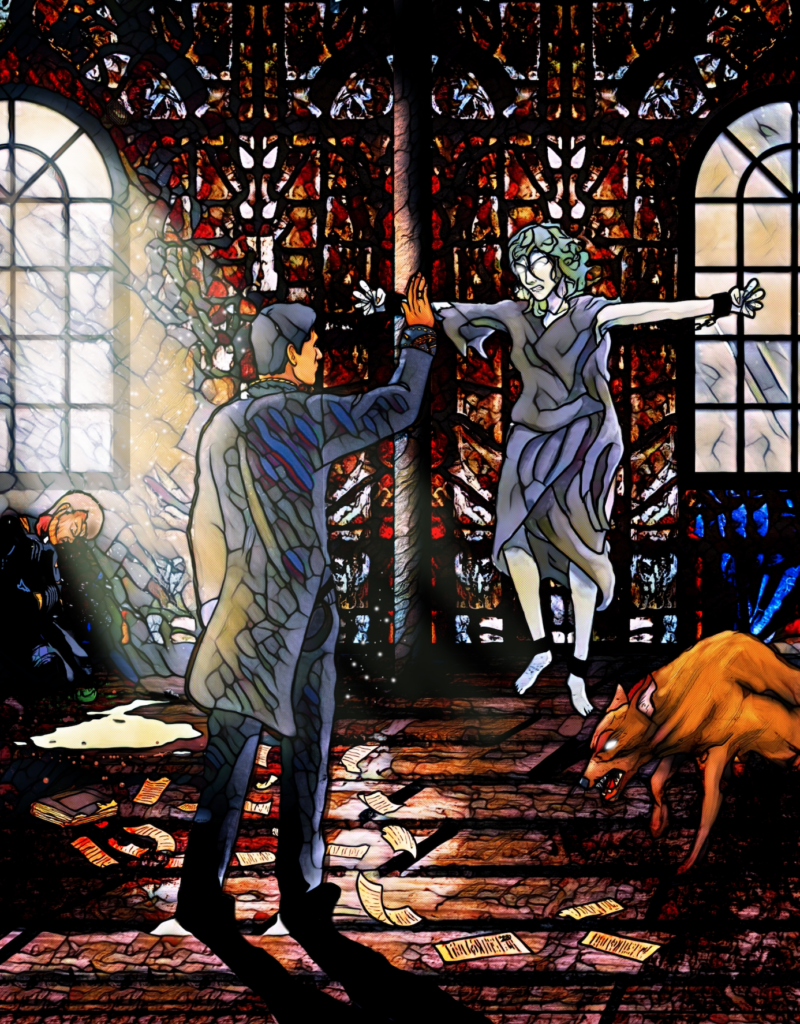
Seeing what The Man was achieving with his mere presence, the woman overflowed with animosity. She roared furiously as multiple, unnatural voices resounded from the depths of her spirit. Hovering higher into the air, she maneuvered to display her malevolent dominance. The Man was unmoved, though, and in response he extended his arm and waved his right hand, directing the ring over her position. This outstretched her arms to their sides and pulled her legs taut beneath her, as if she were being nailed to a cross. The transparent waves washed over her as well, and as they did black ash flaked madly off her entire body with each pulse of energy.
The possessed woman grew increasingly furious. The room rotted at an accelerated rate, causing the wood to creak loudly as she gnashed her teeth and breathed heavily through a clenched jaw. Saliva wisped from her mouth with each exhalation, before eventually she shouted in a demonic tone, “SOLOMOOOOOOOON!”
Deacon Giovanni looked on in absolute shock. The Man, known to the faithful as Seraph Solomon, was simply holding his hand over the woman as if he were silently praying for her. The Ring of Solomon on his hand amplified the transparent waves of energy, sending booming ripples all around. It was then Seraph Solomon turned towards the deacon, revealing the side of his face. He made eye contact with the clergyman as the evil entities inside the possessed nun vociferated relentlessly. Black mist continued to emanate from her body as each pulse of Solomon’s power drowned her whilst suspended in midair. Then, in the blink of an eye as Deacon Giovanni remained paralyzed with awe, incapable of taking his eyes off the magical experience before him, the door to the bedroom slammed shut.
==
Christopher Ikpoh is Co-Founder and President of The Creative Extreme, an entertainment company specializing in creating content for TV, film, animation, comic books, novels and short stories. Their cornerstone endeavor, “Project365”, saw them release one original comic book character for every day in 2016, creating a layered multiverse in one epic saga. Christopher is responsible for operating and managing every aspect of the company with his co-founder, including all strategic business planning, creative direction, story and character creation, editing of content, as well as serving as head writer.
Christopher is also the founder of The Christopher Isaac Society, which is a personal literary brand under which he writes novels, short stories, continual fictional series, poetry, narratives, and journalistic musings.
Christopher is a graduate of Oberlin College. He has a career in Finance as a Vice President for JP Morgan Chase, and he currently resides in his home city of Chicago, IL.
You can find Christopher at:
www.thecreativeextreme.com
www.
He are my social media handles:
IG – @thecreativeextreme, @thechristopherisaacsociety
FB – @thecreativeextreme, @thechristopherisaacsociety
Twitter – @creativeXtreme1
Adrian Kane by Christopher E. Ikpoh
Adrian Kane
by
Christopher E. Ikpoh
“Shh! Shh! No, no, no! Don’t be scared. You can’t even hear them!” The doctors watched their patient frantically pacing in the dimly lit, padded room from the other side of a two-way mirror. Both took notes as the patient continued to exhibit numerous types of psychosis. “I won’t hurt you! Why don’t you UNDERSTAND that? Jeez… I won’t. See!” His hands shot up in the air showing they were empty and then he placed them behind his back. “You should hear the things they are telling me. You’d be scared if you did. THAT would give you reason to be scared,” the man continued while wagging his finger. The observers recorded everything. Then, the door behind them opened. It was Dr. Graham Mitchell, the senior psychologist of the mental health team visiting Holy Trinity Monastery to oversee the patient. His tall, fit frame emanated a vibe of cool swagger and confidence.
“How is he?” Graham inquired to the present doctors while watching the man through the glass. They shrugged slightly; indicating everything with the patient appeared to be what they were accustomed to. “Ok. I’m going to head in and try to get some alone time with him before the God Squad shows up.”
Graham started to close the door, but that is when one of the two doctors replied and halted his exit. “Dr. Mitchell, they are already here.”
Graham let out a sigh of disappointment. “Damn it. Of course, they are.” The two doctors wished him luck, one with a slight smile and the other with a head nod, before the door closed all the way.
Five paces gave Graham enough time to reset his facial expressions from frustration to a professional blank stare as he turned the corner and approached the God Squad. Before him was a shorter, older man dawning silver hair with an unmistakable firmness about him. His name was Father Richard Briton, and he was accompanied by the nuns Sister Bernadette, Sister Agatha and Sister Lucille, as well as a monk named John Knight. Father Richard extended his hand towards Graham and said, “Good evening, Dr. Mitchell. I am happy to see you have not begun speaking to Adrian without us this time.”
“If I’m being completely honest, it wasn’t from a lack of trying,” Graham replied.
Sister Agatha blurted, “The Power of Attorney explicitly states you are not to speak with Adrian unless Father Richard is present.”
Perturbed, yet, politely, Graham retorted, “Thank you, Sister Agatha, for that reminder.”
“Come,” Sister Bernadette interjected, “let the good doctor and Father Richard tend to the boy.” She began ushering the nuns and Pastor Knight towards the waiting area. Her gesture was acknowledged by Graham with a silently mouthed “Thank you” as the group walked off.
Before Brother Knight left though, he turned to Father Richard and gave him a tape recorder while saying, “Oops! Father, don’t forget this.”
“Thank you, son,” Father Richard remarked.
“You are recording the sessions now, as well?” Graham queried of the priest while the young man caught up to the nuns.
“Brother Knight has a bit of ‘residential experience’, if you will, within your medical world. Through the power of Christ our savior, though, he was delivered unto the sanity of the mind and clarity of the soul. Now, he is beginning to teach a course on demonic possession to his fellow brothers and the nuns at his monastery. He’s a powerful leader. Rooted deeply in faith.”
“Sanity through the power of Christ, huh? Maybe he should come with us,” joked Graham.
“No person in their right mind would enter this room.”
“So, he’s scared then?”
“His curiosity and willingness to study the recordings is more bravery than most religious men have, doctor.”
“Then, it is you that is scared.”
“Any sane person would be.”
“If so, why do this every week?”
“Because I made a promise to Adrian’s mother before she died, before he was placed here in the very place she founded. That promise was I would help save my nephew.”
“A brother’s word to his sister now beyond the grave, to be kept until fulfilled. I respect that.” Graham pulled out his ID card and placed it on the security monitor to unlock the padded room before opening the door. “After you,” he gestured to Father Richard, who made the sign of the cross before entering the threshold. Graham followed right behind, and as the door closed, all three nuns and Brother Knight could be seen holding hands and praying with their heads down amidst rays from the sunset peering through the lobby window’s blinds.
As the two entered the room, the dim light slowly crept into their eyes as their pupils adjusted to the darker surroundings. Graham gently pressed the door closed which was accompanied by a beep and locking sound. As he turned to face the room, he noticed Father Richard had stopped dead in his tracks and was staring at something as he muttered an Our Father prayer under his breath. Graham immediately traced the father’s line of sight into a dark corner on the far side of the room. Adrian was sitting in a steel chair rocking back and forth while whispering loudly to himself in an unidentifiable myriad of languages. Father Richard looked disturbed, and as he shuffled the beads on the rosary through his fingers, Graham placed his hand on the priest’s shoulder to try and calm his nerves. Then, the doctor said, “Adrian, I’m here with Father Richard. We would like to talk to you for a moment.”
The whispering ceased, as did the rocking. Adrian slowly sat up straight in the chair while still facing the corner, blending in with the shadows. The air in the room became dense, as if the weight of continuous pressure were being oppressed on the doctor and the priest. Their eyes felt awkward and their ears began to close slightly, inhibiting their hearing. Father Richard placed his pinky fingers in his ears and wiggled them about. Graham pinched his ear lobes and tugged on them to open his ear canals. With both of their hearing restored to full capacity, a low murmur was heard. Adrian seemed to be making a subtle, guttural noise in his throat with his mouth closed.
Father Richard began walking over to Adrian, but Graham placed his hand in front of him to impede his progress. Then, the doctor motioned for the priest to wait as stillness overcame the room. It was silent. Absolutely silent. The air was heavy. A lump grew in Father Richard’s throat. Finally, just as the tension mounted to great heights, Adrian abruptly let out a bellowing, maniacal cackle.
One of the doctors on the other side of the glass jumped, fumbling their pen and dropping it on the floor. This startled the second doctor. Both were on edge. The uneasiness in the padded room was palpable. As the first doctor picked up his pen, he said, “Jesus fucking Christ. I hate it when he does that.” The second doctor agreed, loosening her collar under her lab coat to relieve stress that was building in her shoulders and neck.
Meanwhile, Graham stood intensely focused, yet, calm and collected. Adrian’s psychotic behavior, regardless of how bizarre it appeared, did not break him from his resolve to help his patient. He motioned for Father Richard to be seated and he took the chair next to the priest. “Adrian, do you care to join us?”
The chuckling stopped. Adrian turned his head slightly to look back at the two men, and then inched his chair towards the metal table in the center of the padded room keeping his back to them. The metal chair legs caused an incredibly piercing, high-pitched noise with each motion backwards. The constant shrieking sound was like a deafening alarm that would not be silenced. After a dozen or so seconds, though, Adrian finally reached the table side. He did not turn to face the two men, however.
“Adrian,” the priest said as he placed the already recording device on the table, “it is I, Father Richard. Will you not turn to face us?”
Adrian rolled his head in a circle before exhaling. His voice was deep and muffled, sounding utterly unnatural. As he stared out the window in front of him at the trees, he answered, “Well… if it isss… isn’t Poppa Dick.”
Graham interjected, “You should respect Father Richard, Adrian. He is here to help you, as am I.”
“Help?” Adrian replied in a cynically inquisitive manner. “What makes you think we need help?”
“Please turn and face us. It is rude to speak to someone with your back towards them.”
Adrian sharply rotated his chair and stared at both men. His eyes were bloodshot red. His face held lines of stress and tension all over. Underneath his eyelids were dark blue bags. He had not slept in days. Both of his lips looked like old, cracked leather, covered in moisture from saliva that was oozing from his mouth. Possibly most disturbing though, is that Adrian never blinked. Days with no rest, and yet, his eyes never twitched once. Father Richard remarked, “You don’t look well, nephew. How are you?”
In the same, monstrous voice, Adrian replied while staring at Graham, “Dr. Mitchell, did you know that traditional Catholic masses are held in Latin, and the priests perform the entire ceremony with their backs to the congregation? I would say that is INCREDIBLY rude.” He then shifted his gaze to Father Richard and continued, “Not very becoming of God’s servants, now is it?”
“Adrian, please stick to one topic at a time. How are you feeling today?” Graham queried.
“Adrian is not here,” the patient responded.
“With whom are we speaking with?” Father Richard inquired in return.
“Wouldn’t you like to know?” Adrian retorted, alluding to the fact in Catholic exorcisms, it is stated the priest must get the name of the demon possessing the person before they can drive them out.
“Can we speak to Adrian then?” Graham asked next.
Adrian closed his eyes, gnashed his teeth, and tilted his head sideways at an angle while it shook slightly. After a moment, he sat in a normal position and exhaled heavily. Then, Adrian spoke in a calm voice familiar to Father Richard and Graham. “Dr. Mitchell, thank you.”
Taking notes, Graham said while writing, “Who were we just speaking with, Adrian? Was it Amdusias?”
Gently, Adrian nodded. “Yes. He said he had another concert for me to listen to. He wanted you both to listen, as well. He… he twists the trees about madly. His voice, it is terrifying. None of us like him very much.”
“Amdusias?” Father Richard asked in a very pensive tone.
Graham answered, “Yes. Shortly after your last visit, the Amdusias personality developed. Holy Trinity had a visiting band perform for the patients as a way of mixing up the monthly entertainment. Adrian took to the performance and developed a new personality using the cover of Amdusias to express his feeling of musical superiority over the quality of the band’s musicians.”
“Dr. Mitchell,” the priest replied, “Amdusias is said to be the demon over the cacophonous music played in Hell. He is known as the Great King, commanding 29 demons.”
Adrian tilted his head slightly again and began biting his nails frantically. In between nibbles, he pointed at Father Richard and said in a perfect sounding, high-pitched, feminine voice, “Yes! Yes! That’s him! His friends are scary. I don’t like them, any of them. All 29 are vicious and cruel.”
“Mary Rae, is that you?” Graham asked while flipping through his notes, seeking his information from previous sessions in which Adrian displayed behaviors from a personality named Mary Rae.
Without answering the questions, Adrian shivered and began rubbing his arms before asking, “Good Lord, it is quite cold in here. Are you two not freezing?”
Father Richard noticed a slight chill on the exposed skin over his face, neck and hands. “It is getting colder in here.”
“Holy Trinity is 37 years old, father,” Graham said. “These windows are terribly drafty.”
Adrian slammed his fist onto the table, alarming Graham, Father Richard, as well as the two doctors behind the glass. Next, he sneezed six consecutive times, squeezing his eyes closed in the process. “Adrian?” Father Richard said meekly. The slow, bellowing cackle returned. “Amdusias,” the priest continued with a change of demeanor in his voice.
“Dr. Mitchhh… Mitchell, I LOVE a man of science. You have an answer for everything. Tell Poppa Dick it is only the drafty windows again. I don’t think he believes you.”
“Can we speak with Adrian, please?” Graham inquired.
“I want more answers!” Adrian screamed in an ugly and angry tone.
Father Richard clutched his rosary. Graham then replied with a question. “Answers to what?”
Adrian smiled a devilish smirk and proceeded. “I can sss… smell the blood on your lady doctor in the other room. She is leaking as we speak.”
The female doctor in the other room became very uncomfortable but maintained her composure. Just then, Adrian tilted his head back and inhaled deeply through his nose before turning to look at the female doctor through the two-way glass while cackling again. “The BITCH is in heat! Dr. Mitchell, can I satiate her desires?”
“Adrian, you will respect my colleagues. And you know direct contact with any of my staff besides me is strictly forbidden,” Graham answered as he continued to jot down notes.
Father Richard spoke next. “Your sexual deviancy will not pollute Adrian, Amdusias. I will not allow it. My nephew is a good man.”
Once again, Adrian cackled, sending chills down the spines of the priest and the two observing doctors. “Is that so, FATHERRRRRRRRRRRR?” Adrian shook his head and then slammed his fist six times on the table again before continuing. “Tell me, Dick. If I were to fuck her to ecstasy and make her squirt all over the room, would you be able to bless the juices turning it into holy water before it landed on your pious face?”
“Quiet, demon!” Father Richard exclaimed as Adrian maniacally cackled.
Graham placed his hand on the priest to calm him. Then, he asked Adrian, “Are you having feelings of sexual frustration? Where do you think these desires of aggressive intimacy are originating from?”
“I’m no more sexually frustrated than a 68-year-old priest who hasn’t touched a young boy in years, Dr. Mitchell…,” Adrian answered while looking directly at Father Richard’s disgusted expression. “Or perhapsss you would enjoy joining the orgy circle between Sister Agatha, Sister Bernadette, Sister Lucille and young Brother Knight. I’m sure that would be a BLAST!”
“Adrian, you have not answered my question,” Graham interceded.
“In due time, Dr. Mitchell. Right now, I’m curious about Poppa Dick. See, he would NEVER go for the orgy. His feelings of inadequacy are too great. His prick would only feel big in the ass of a child. God KNOWS if he really wanted it to feel huge, he wouldn’t hesitate to put it inside of a…”
“Adrian!” Graham interjected the psychotic rant sternly, which only made the patient snicker once more. Adrian then hit himself in the head six times with a closed fist while muttering. “There is no need to hit yourself,” the doctor said.
“Stupid! Stupid! Stupid! Stupid!” Adrian repeated with each punch in a small child’s voice. “I’m sorry, Dr. Mitchell. I am not being much help. I told Adrian I would try to control Amdusias with him. He is getting stronger by the day, though. We are trying. All of us are, truly, but nothing is working.”
“William, when did you and Adrian speak about this?” Graham inquired to the new personality on display.
“As soon as Amdusias showed up and began raging on all of us. He was scratching everyone with his claws, saying he was marking his territory. I don’t want to be marked, Dr. Mitchell. I hate staring at trees. They don’t look right bending that way.”
Father Richard spoke next. “Did Amdusias say what he wanted from Adrian?”
“He wants his soul, father. But first, he wants us all to attend his concerts of torture. They are horrific! I can’t take them anymore. He brutally punishes us; lures us to his chamber with his singing, and then he does strange things, such terrible things.”
“What does he do, William?” Graham asked.
“Bludgeoning with his unicorn horn. Rape. Strangulation with snakes as they dig their fangs into us. Shh! Shh! He’s coming! Oh no!” Adrian began to pant heavily and get frantic after ceasing his retort.
Graham put his pen down and said calmly, “William, relax. It is ok. Focus on us. Look at me and Father Richard.”
“No! NO! Get away! GET AWAY!” Adrian continued to scream in a panic while swatting at the air around him. “Their hands are all over me! Stop touching me!”
“William… William,” Graham continued. “Please, calm down.”
Father Richard began calling out to his nephew to fight back while saying prayers in Latin between his pleas.
Graham looked at the priest as to silence his seemingly encouraging tone towards the chaos his patient was experiencing. It was then Adrian’s body went limp and his face slammed against the metal table from free falling. “Adrian? Are you alright?” Graham asked a few times.
Adrian slowly placed his hands flat on the table and lifted his torso upright. He then rubbed his cheek and grimaced slightly before responding in his normal voice. “Ugh… William is safe. I grabbed him and leapt to safety. Amdusias and his demons are relentless.”
Father Richard breathed a sigh of relief much to Graham’s dismay, who went back to his clinical treatment of Adrian. “With William safe, are the other people safe too?”
“Yes. Amdusias does not know where they are hiding,” Adrian answered.
“Do you know how long they have before they will be found? Before Amdusias finds the rest?” Graham followed with.
Adrian was still rubbing his cheek and said, “I don’t know, a week or so… maybe. If they are lucky. I keep him away as long as I can.”
Graham looked at Father Richard in a manner displaying a sense of correctness in his approach to the session, and then replied, “Just in time for Father Richard’s return. Ok, Adrian. Monks will be in shortly to return you to your room.”
Father Richard looked at Adrian and said, “Don’t worry, nephew. We are going to make you better. You keep fighting. I will be back soon. I promise.”
With that, Father Richard and Graham stood and began exiting the room. An unlocking sound entered the ears of the two men as the doctor grabbed the door handle. Then, the haunting cackle returned. It permeated throughout the room like thunder over the night sky. The two doctors behind the glass shook again, while the woman said under her breath, “Just get out of there, Dr. Mitchell.”
Adrian cackled madly. Father Richard and Graham turned to face Adrian, and as they locked with the blood shot, dark eyes of the patient, he said in the disturbing, deep voice of Amdusias, “I cannot WAIT.” Then, he laughed maniacally as the doctor and the priest exited and closed the door, triggering the locking mechanism behind them.
Father Richard placed his hands on his knees and breathed deeply as does a person who has been underwater to the point of drowning before finally emerging. The nuns and Brother Knight ran over upon seeing this. Graham also breathed deeply, but in a calmer and more collected manner. It was as if a giant weight had been lifted off their chests. “Are you alright?” Graham asked Father Richard.
Sister Bernadette grabbed the priest’s arm and helped him stand erect. Father Richard gathered himself as well and then answered, “I am alright, Dr. Mitchell. I am alright.”
Brother Knight sensed the gravity of the session which just took place. In a concerned tone, he queried the priest, “And Adrian. Is he alright as well?”
Father Richard answered, “I am afraid not.”
However, before he could finish his statement, Graham interrupted. “He is not well mentally. Adrian suffers from multiple personality disorder, psychopathy, sociopathy, and paranoia amongst other inflictions which I have not had the opportunity to fully explore and diagnose yet.”
The nuns looked at Graham as if he were speaking a foreign language, as did Brother Knight who replied, “The man is possessed, doctor. I have listened to the copies of your recordings that you share with Father Richard. His body houses numerous demons, high ranking evil spirits in the hierarchy of Satan’s kingdom. It is clear as day.”
“Dr. Mitchell is a non-believer,” Father Richard told the pastor. “To him, science can explain everything that is wrong with Adrian, even though certain things have no reason behind them.”
“Time,” Graham retorted, “is the great bridge between the unexplained in science and the falsely explained in religion. When there is an occurrence that science has not yet resolved, religion lays claim to it through explanations of mystical awesomeness. Time eventually allows science to discover a perfectly natural explanation, disproving that mysticism, allowing everyone to sleep better at night knowing the skies are not going to rip open at the witching hour sounding trumpets signaling the end of time.”
“Adrian…” Father Richard proclaimed, “… my nephew, he is afflicted by dark entities. The devil does not need your belief in order to exist. So, whether you will admit it or not, Adrian is possessed, my friend. And now we know the name of the demon inhabiting him. We can exorcise my nephew and save his soul.”
The heavy conversation was halted when a sharp, aggressive noise was overheard from inside the room where Adrian was. The sudden outburst frightened everyone. It was this audible display of insane behavior startling the doctor, coupled with the words of the priest, that led Graham to become overwhelmingly agitated. “No!” Graham retorted sternly, visibly perturbed. “He is not possessed. He is sick; very, very, very sick. His mental state is incredibly fragile, and it will take quite a long time to piece it back together, which is becoming overwhelmingly difficult every time you go in there and begin enabling his psychosis with your chants of ‘Hoo rah rah!’ and ‘Fight! Fight! Fight! Win!’ like you’re God’s cheerleader. This is not a matter of demonic possession. This is a matter of deeply embedded trauma in a young man caused by numerous events, culminating in the death of a greatly, mentally disturbed woman who was able to hide behind her massive fortune and resist proper psychological medical care – who most probably genetically and most certainly conditionally – passed on her numerous psychotic behaviors to her son who is on the other side of this door. So, forgive me if I don’t buy into your dogmatic approach in trying to heal Adrian. It has been my responsibility as a doctor to do what is best for the patient since Adrian’s mother’s estate appointed me to work with your nephew alongside you, and showering him in holy water while screaming at him for days that he is a demon just isn’t going to happen on my watch.”
The nuns were stunned, as was Father Richard and Brother Knight. They knew Graham was not a religious person in the least, but they never expected such a visceral reaction to come from him. Sister Bernadette looked the most disappointed and hurt by Graham’s words, though. She said, “What happened to you that caused such a disdain for the Lord and His works?”
Graham paused for a moment, realizing he was getting worked up and confrontational. After collecting his thoughts, he answered calmly, “Look. I’m sorry for getting adversarial. It’s just… I have seen too many people die at the hands of religious fanatics because they believed the individual’s symptoms were demonic and not biological. That is what has made me this way. Plenty of perfectly curable, mentally ill people have suffered from the disillusions of holy men and women for centuries. I won’t let that happen with my patients.”
Father Richard was not convinced Graham’s small outburst was because of his explanation, though, and he called the doctor on it. “No, Dr. Mitchell, you did not get worked up because you don’t want us to exorcise Adrian. You are worked up because you are starting to believe there may be things taking place in my nephew that are actually unexplainable, and it has you at a loss.”
Taken aback by the priest’s words, Graham looked at the nuns and Brother Knight while hesitating to speak before replying, “I assure you that is not the case.”
“In one of your reports, you stated trauma suffered by Adrian’s mother during her pregnancy most likely made micro-indentations in his genetic code, leaving him more predisposed to psychosis than the he already was. You also said it is most likely Adrian has suffered from these mental illnesses since he was a child due to not only the genetic inheritance from his mother, but also because he was raised in an environment where his mother subjected him to her psychosis on a daily basis. Nevertheless, Adrian did not begin exhibiting any symptoms of mental illness until his mother passed. He led a perfectly normal life up until that point. How could that be so if he were impaired before he was even born, and then grew up in a world of insanity all around him emanating from the person he loved the most in this world, his mother, my sister?”
Graham stood and processed the words of the priest before answering, “Sometimes, an individual will only display faint hints of mental illness during their life until a greatly traumatic event occurs, pushing the psychosis to the forefront as it begins to consume the individual.”
“Or,” Father Richard replied, “Adrian was never mentally ill, and the demons his mother fought her entire life through the power of faith under God’s protection were passed on to her son after she lost the battle against them.”
“I cannot speak to those claims as I was not privy to the medical state of Adrian’s mother, nor his own before he came under my care. However, I am confident in saying it was her death that triggered already present psychosis in Adrian, as opposed to a transference of demons.”
“You will see, my good doctor. One day, you will see the true nature of what we face, and I pray to God at that time you have the fortitude to admit you are wrong and aid us in helping Adrian the only way that will work,” Father Richard told Graham.
“And by that I take it you mean with an exorcism?” Graham inquired condescendingly.
Before the priest could rebuttal the doctor’s words, Brother Knight inquired, “Father, where is the recorder?”
Father Richard tapped all his pockets and dug through them but could not find it. He had left it in the room with Adrian. Realizing his absentminded mistake, the priest glanced at the door. Graham, realizing Father Richard was hesitant to go back into the room, said, “I will go get it. Give me a moment.”
“Thank you,” Father Richard replied.
Graham used his ID card and unlocked the door to the padded room, swinging it open after the beeping noise. As he entered, he noticed the temperature had dropped significantly. Adrian was standing in the dark corner again, fondling himself as blood trickled from his mouth. Disgusted, but composed, Graham said, “Adrian, that is unacceptable behavior. Remove your hands from inside pants.” Adrian complied with Graham’s orders, and then Graham continued, “Why are you bleeding from your mouth?”
The deep, grizzly voice of Amdusias answered, “Adrian insisted on not telling me where William and the others are. So, I bit his tongue to loosen it. Apparently, he would rather have holes in his tongue then give them up. I admire his resolve, but I will find them, and they will wonder in awe at the magnificence of my torturous symphony.”
Adrian’s words seemed to be nothing but honest and were convincing. In that moment, for some reason, a part of Graham started to believe the statements exiting Adrian might not solely be a product of his psychosis. It was the darkness in Adrian’s eyes that captured the doctor’s, along with the wicked serenity in his voice that gave Graham a sense of worry. Reasoning quickly dominated the doctor’s mind, though, as his consciousness cycled through the vast library of psychological knowledge he possessed, seeking to provide a rational explanation for Adrian’s behavior and speech. Grabbing the recorder, Graham told Adrian, “I will send some orderlies in to tend to your wound.”
As Graham exited and began closing the door, Adrian collapsed, signifying a return to normalcy. He spoke in his regular voice while on his knees and exhausted, “Thank you, Dr. Mitchell. I’m fighting. I really am.”
Graham swallowed the tension in his throat as he sympathetically glanced at Adrian before sealing the door shut behind him tightly. While handing Brother Knight the recorder, the doctor motioned to a Holy Trinity nun to come to him. He whispered in her ear to tell some orderlies to bring medical supplies and tend to Adrian’s tongue injury. Noticing this, Father Richard asked what was going on. Graham swiftly answered convincingly, “Nothing. It is time for Adrian to return to his room. I was informed upon arrival that the security guard over there, Reggie, will help us retrieve our things at the security gate up front. You should head out. I must confer with my colleagues here before we leave, though, and review our notes while the events of the session are still fresh.” Graham motioned for Reggie to come over.
“Thank you, Dr. Mitchell,” Father Richard expressed.
“Until next week. Father, sisters, Brother Knight, have a good evening,” Graham replied as he walked away holding his notepad and pen in his right hand while he ran the fingers on his left through his hair.
As the nuns and Father Richard followed Reggie on their way out, curiosity overcame Brother Knight. He hit rewind to listen to a quick snippet of the end of the recording. However, instead of just hearing the last words spoken before Graham and Father Richard exited the room, Brother Knight heard a small commotion in the distance picked up by the recorder. Then, the sound of nails scraping across the metal table rang through the speaker. Heavy breathing was heard next. This was followed by Adrian speaking in Amdusias’ voice. It was filled with rage, villainy, and a predator-like tone. “Brother Knight, welcome to my symphony. I’ve been expecting you.” Finally, a loud, terrifying roar blurted from the speakers. It was the noise which frightened everyone only moments earlier. Brother Knight froze in his tracks. He became filled with fear. Adrian could not have known he was there, and the monk knew Father Richard would never mention him to Adrian. The maniacal growl continued as Brother Knight turned slowly.
Adrian was being ushered away by monks and orderlies to his room. As Brother Knight made eye contact with him, the devilish noise filled the hallway, causing the monk to go deaf. His ear drums were in immense pain, throbbing each time the roaring began over again. Then, amidst the two locked in a gaze, the monk heard the real voice of Adrian in his head. It was a mere whisper, and it said, “Brother, run.” However, simultaneously, Adrian mouthed the words, “Die,” and as soon as Adrian’s natural voice faded, Brother Knight heard screams of sheer terror and pain all throughout his mind. He could not stop looking at the darkness in Adrian’s eyes, and before he knew it, the intense screaming in his brain and the pounding of his ear drums listening to the sounds on the recorder caused Brother Knight to collapse on the floor.
Father Richard and the nuns heard the noise of their friend hitting the ground, and immediately ran to his rescue. As they arrived over his body, they cradled his head and shook him gently attempting to revive him. Brother Knight was not breathing. Father Richard looked up as Graham came running over, as well. He witnessed Brother Knight collapse from not too far away down an adjacent hallway.
As the priest and the doctor looked at each other, they heard Adrian’s psychotic roar through the recorder speaker, and looked down the hallway towards Adrian being led away by the orderlies. He simply smirked at them in a very devious manner as he passed the corner and exited their sight.
==
Christopher Ikpoh is Co-Founder and President of The Creative Extreme, an entertainment company specializing in creating content for TV, film, animation, comic books, novels and short stories. Their cornerstone endeavor, “Project365”, saw them release one original comic book character for every day in 2016, creating a layered multiverse in one epic saga. Christopher is responsible for operating and managing every aspect of the company with his co-founder, including all strategic business planning, creative direction, story and character creation, editing of content, as well as serving as head writer.
Christopher is also the founder of The Christopher Isaac Society, which is a personal literary brand under which he writes novels, short stories, continual fictional series, poetry, narratives, and journalistic musings.
Christopher is a graduate of Oberlin College. He has a career in Finance as a Vice President for JP Morgan Chase, and he currently resides in his home city of Chicago, IL.
You can find Christopher at:
www.thecreativeextreme.com
www.
He are my social media handles:
IG – @thecreativeextreme, @thechristopherisaacsociety
FB – @thecreativeextreme, @thechristopherisaacsociety
Twitter – @creativeXtreme1
A Modern Mary Shelley by Dawn Vogel
A Modern Mary Shelley
By Dawn Vogel
Mary’s the sort of girl most people don’t really notice. She sits in the back of the classroom, always scribbling in her notebook. She sits by herself at lunch, though you’re not sure she eats, because she’s still writing while the chaos of the cafeteria swirls around her.
You track her down on social media, picking her out among all the other Mary S. accounts. She only posts beautiful things, but if you dig a little farther, you realize they’re both beautiful and morbid—skulls and bones and decay, carefully arranged into something lovely.
She’s got quite the following online, other artists like her, all with the same aesthetic. The compliments they pay each other read like poetry, and you lose yourself in their world for a little while.
Mary shies away from you the first time you say hello. She’s not accustomed to people being friendly to her, nor is she much of a conversationalist. But she’ll listen as you talk, prodding you to continue with appropriate nods and sympathetic noises. You’ve tried just sitting in silence in her presence, but her pen is always rasping over paper when she’s not expected to participate in something, and even sometimes when she is.
You invite her over for dinner, because that’s what new friends do, even if it means exposing her to your family and siblings. You hope they’ll be on their best behavior if you bring home a guest. But it doesn’t come to pass, because she demurs, citing other plans.
She never invites you over to her house. Maybe her family is worse than yours.
You follow her home from school one day to find out. You’re not surprised to learn she lives in the old part of town, in a house that looks like it might only be held together by hopes and dreams. You’re relieved she’s never invited you over.
But you’re curious, and you’ve already come this far, so you skulk around the yard a bit, trying to get a glimpse inside her house. They say eyes are the windows to the soul, and you suspect it might work the other way around too.
The first level windows are mostly covered with thick, elegant draperies. The ground level windows, however, lack such coverings.
You wish they had been covered. It was easier to think of Mary as a shy, eccentric artist.
There’s artistry in what she’s doing, to be sure, but you never would have guessed all that scribbling in her notebook was not poetry, but rather plans.
Plans for a patchwork human, lying prone on a slab, electrodes and wires attached to various parts.
You really shouldn’t have followed her today. You didn’t need to see this patchwork human jolt to life.
You didn’t need it to notice you lurking outside the basement windows, transfixed.
You didn’t need Mary to see you there.
It would have been much better if you’d just left her to her scribblings.
==
Dawn Vogel’s academic background is in history, so it’s not surprising that much of her fiction is set in earlier times. By day, she edits reports for historians and archaeologists. In her alleged spare time, she runs a craft business, co-runs a small press, and tries to find time for writing. Her steampunk adventure series, Brass and Glass, is available from DefCon One Publishing. She is a member of Broad Universe, SFWA, and Codex Writers. She lives in Seattle with her husband, author Jeremy Zimmerman, and their herd of cats. Visit her at http://historythatneverwas.com
The Annals of Draceas: An Entry
by
Erol Engin
I first came to the village of Draceas on October 5, 1901.

To reach it, one must conduct a steep ascent of some 1,000 feet along the Turnu Rosu (Red Tower) Pass, a perilous highway through the Carpathian Mountains connecting Wallachia with Transylvania. It is said that in the middle 1400s Vlad Tepes himself, on a retreat from a campaign against the Turks, used the very same Pass to cross into Transylvania.
The scene would have changed but little since those times. The same mountains rose majestic and changeless on either side of us, and the dark waters of the Olt River burbled as it had for time out of mind.
As we made our ascent, I reflected on recent events in my life. I had taken sabbatical from the University of New South Wales, and had come to Europe three months before. I wished to observe the rituals of the Transylvanian gypsies and the Seven Slavic Tribes. By studying their lore and legend, I hoped to further Jung’s assertion that ritual raises us from the human to the divine.
I must admit to another, less cerebral, reason. I had once loved a woman, the daughter of a wealthy and respected donor to the university. While my star as a psychoanalyst rose, we became engaged, and set the wedding date for October of this year.
It was not to be. My growing interest in the darker realms of the psyche – human sacrifice, blood rites and ancient rituals – alienated me from my peers. They preferred not to be reminded of, say, the Great Death Pit at the ancient city of Ur, Incan child mummies, or the blood rituals of the Dahomey kingdom in West Africa. Nor did they like my revelations of the bloody practices of the Romans, Celts and ancient Greeks. I maintain now, as I did then, that I used the bodies in accordance with strict medical procedure. I did examine their brains; I do not deny it. How else could I show that the minds of those who practiced ancient rituals, no matter how bloody or primitive, were of a higher order than modern man’s, who rejected them?
When word of my arcane studies leaked out, Catherine – there, I have written her name for the first time in more than a year – broke off our engagement. No man suffered more bitterly: if I could not possess her, then no man would. After what occurred, I needed to escape, to lose myself in my work. The wilds of Eastern Europe, to say nothing of its rituals, appealed. I vowed that I would find there something that would restore my academic standing. Only then could I return to Australia and reclaim my honour.
So, I was most keen to press on. I had hoped to cross into Bulgaria before nightfall, but soon it became clear that our draft horses – two strong Hanoverians – would need rest and food before climbing the Pass.
The over-taxed beasts pulled round a long curve. Slowly, a church bell-tower hove into view. Spread out in a wide circle around the church were perhaps four hundred shack-like homes: my first sighting of Draceas. We had passed many a village of its kind. Though I did not relish the idea of stopping, we decided it would be best for the struggling beasts. We started our descent from the Pass.
My eyes were immediately drawn to something beyond the village. The mountainside was dark green, intensely so – in fact, I did not expect to see such a beautiful and melancholic sight here. The gentle dying rays of the westering sun seemed to caress each tree and leaf of the forest into brilliant life, and the line of the slope into a sensuous, even ponderous, curve. The view struck me immediately, powerfully, as if this was a long sought-after destination at last reached, though, of course, this could not be.
At the foothills of the mountain lay a contrasting sight: a riotous tangle of overgrown shrub and knotty vine. This thicket-like patch was very large, stretching for perhaps half the size of a football field. And amongst the dull, weed-like green of this lesser shrubbery ran veins of grey, rotting wood: the remains of some large structure, or structures, now almost entirely hidden by the wild overgrowth.
Another curious thing: as we descended from the Pass, I turned away from the mountainside to notice that on the eastern side, almost directly opposite the strange overgrown structure, the village was dominated by the presence of a lofty tower. Its pointed shadow thrust like a stake through the heart of the village. If we had continued along the Pass, it would have taken us right under its watch. But instead we veered from it onto a track that cut a winding, bumpy descent to the village.
I kept my head outside the cab. The autumnal air felt fresh and biting on my cheeks. The tower had a peculiar coloration, a kind of dullish red ring, near its base. And perhaps three quarters of the way up its shaft was a large round window that, despite its size, seemed dark and impenetrable, more like an embrasure in a castle wall than a true window. An odd longing to gaze through it stirred within me. Would it not command an excellent view, not only of the village, but also of the overgrown structure and lovely deep green mountainside?
The tower receded as we approached the town. Yet I continued to study it. There was something at the window, lying on its sill. I could not see it clearly, and with the drafts’ every step it became more distant. It was very pale, almost white, yet parts gleamed and glinted like jewels. A stone decoration?
I retired back inside the cab. I must admit to having felt very strange indeed. Uncomfortable, even.
For my last impression – an impression I could not shake – was that I had seen on the windowsill a very pale bejewelled hand.
***
We stopped at the village square. I ordered the coachman to see to the horses and return within the hour. Before I turned away, I saw that he had grown somewhat sullen and distracted. His gaunt cheeks and long, pinched face made his eyes appear somewhat bulbous. He kept them downcast as I spoke to him, his face marred by some private trouble, I guessed. I counted myself lucky to find him; no other coachman in Sibiu’s drinking halls would go over the Pass.
At last he climbed into the driver’s seat. With a snap of the reins, the horses were off at a weary trot down the rough, narrow lane. But as the pattern of their echoing hoof-falls began to fade from my hearing, the man turned to gaze dejectedly at me. His baleful eyes peered at me over the upturned collar of his jacket. They swelled with what looked to be profound misgiving.
I stood alone now in the village square. There was the old, bell-towered church, a few desultory inns, but otherwise Draceas was little more than a sprawl of peaked split-pine houses modelled after the Russian izba, but cruder. It was strangely quiet. The few people I did manage to glimpse – burly, hunched-over figures in shaggy woollen capes (similar to the suba worn by Hungarian shepherds) – avoided looking at me. When I tried hailing a couple who were approaching, they quickly bundled themselves off around a corner.
Though I could see no one, I myself was hardly unseen. Or, should I say, unfelt? The villagers knew of me. I could not of course provide any evidence for this, other than my own feelings. Every drawn window, closed door and empty laneway confirmed my suspicion: their absence was not mere chance. It was directed at me.
Another thing I knew: I had no desire to linger here.
I turned, and there it was, high up on the Pass: the lofty tower. I thought again of the window, and the strange hand – if hand it was – on its sill. Could it still be there? And what of its owner?
There was a path, I noticed – different from the one that we had used before – cutting down from the tower to the town. Consulting my watch, I calculated that I could perhaps get up it and back within the hour.
Glad of the exercise, I set off, my boots pounding the well-trodden path. Soon I was cresting the hill outside the village. The path climbed steeply at the end, bringing me at last to a lush, grassy plateau spread about the tower’s base. Beyond it the brown dirt road of the Pass rose to a perilous height.
I rested for a time on a small hillock. The village lay below, but I took no interest in its jumble of peasant shacks. Nor did I take any in the Olt, which wound like a giant black viper through the distant rolling hills.
No, it was that intoxicating curve of mountainside that captivated me. The forest green was perhaps an even a richer, darker hue than before. The deeply westering sun’s rays must have added to its depth and intensity, for each tree and leaf seemed to blaze with an inner light.
There are many tales of travellers losing themselves to the wild beauty of the Carpathians. But this was no mere postcard view. I gazed instead upon a mystery, a sacred trust. The wild inner heart of these majestic formations had been revealed to me, and me alone. I vowed, then, to keep this revelation as jealously as I would the love and honour of a beautiful woman. I would suffer no other man to possess it.
After some time, I rose. As in a trance I walked the forty of so feet to the tower. Its grey drystone walling created about it a desolate melancholy, similar to a Scots broch or dun. Indeed, it would not have been out of place in a remote Hebridean weir. Whether by design or accident, the spire did not point perfectly upwards. It appeared crooked, or twisted, as if made by drunken builders.
But it was the red ring about its base that most drew my attention. In the dying light it seemed to change from a pale, ghostly strip, faint yet perceptible, to a deeper, more luminous swathe of burgundy. Crude as the tower itself, the red substance seemed carelessly applied, as if slapped or smeared on. The increasing luminosity revealed what appeared to be handprints, or certainly fingerprints, in the ring.
I walked slowly around the base. The only interruption of its stony greyness was a door of weathered oak on the Pass side. I tried to turn its iron ring but found it steadfastly locked. High above the door were more and more handprints. Perhaps hundreds of years’ worth of them.
I reached up to feel the cold red-hued stone. And then – I do not know why – I began to slap my hand against the red ring. An uncanny sense of union with villagers past resonated within me. Now my slapping turned from mindless ritual to near outright worship. How worthy this enduring monument was – much worthier than I – of the view it commanded!
At last I drew myself away from the tower.
The Red Ring now swelled and grew into a fervid crimson. Before my stunned eyes thick red droplets began to streak like bloody tears down the tower’s shaft, only to disappear when they reached the ground.
I stood back. What had I done?
The window was a black gulf of emptiness. Something fell within me, as though a promise had been broken. I desperately wanted to see the Hand, if hand it was; in fact it had been the sole purpose of my coming to the tower, I realised.
Back I went, until more of the window hove into view.
Suddenly I saw it, a slender-fingered hand, pale as candlewax, its fine-trimmed nails lacquered with black sheen.
But something had changed.
It no longer rested on the sill. Instead, it hovered inches above it, framed by the gaping sleeve of a crimson robe. Its owner lurked in the shadows. But the Hand, and its bloodless pallor, I clearly saw.
And its long, elegant index finger pointed directly at me.
I had been Chosen.
***
By the time I stumbled back down the path to the village, the sun had been halved by the horizon’s rim, and the clouds in the sky glowed like hot coals.
The cobblestone lanes of the town appeared even more deserted and silent than before. The dwellings, which I had first thought humble, now seemed to grow in stature, their izba-like peaks rising up and looming over me – a trick of the light, but unnerving nonetheless. Again that sense of being felt was undeniable: all of the unseen villagers’ thoughts seemed bent upon me, lying in wait, but for what purpose I could not imagine.
My coachman was nowhere to be seen. I had no desire to wander through the darkening village in search of him. All I wanted was to find a quiet place to sit and contemplate what had occurred at the tower.
My weary footsteps led me to the domed and bell-towered church – as good a place as any, I thought, for contemplation.
I pushed its heavy doors open and stepped into the vestibule. Strong aromas of candlewax and incense struck me as I entered the tranquil sanctuary. I stumbled down the nave’s red tongue of a carpet and sank to my knees before the high wall of the templon. I looked up to the elegant doors dedicated to Christ and the Virgin Mary. Above them was a vast panoply of icons rendered in glittering gold leaf.
There was one icon, however, that I did not recognise. It was a painting – hundreds of years old, it must have been – of an extraordinary man dressed in a crimson robe. His penetrating, even mesmerising, eyes were a deep sea-green, set high above vulpine cheekbones and a strong aquiline nose. His skin was a bloodless alabaster, his lips full and as crimson as his robe. Oddly, the painting lay to the left of the Virgin Mary, a truly eminent position, normally reserved in Eastern churches for the icon of the patron saint. But this rapacious-looking man was clearly no saint.
My extraordinary experience at the tower came rushing back to me.
I stood at its base, the dying light of the swiftly westering sun falling weakly upon it. The dusk air had grown chill.
From within me came unbidden these words:
‘Master, what is thy command?’
For a time, there was no sound. Only the distant burbling of the Olt, and the forlorn soughing of trees.
Then this word I heard:
‘Tonight….’
So cold and bloodless a voice could not belong to a man; it was as if the tower itself had spoken.
It came again:
‘Show thy worthiness. Only then can it be thine, and thine alone.’
A frigid cold gripped my heart, and then my hand…my hand…
‘You must leave.’
This new, unexpected voice startled me out of my contemplation.
I turned.
A bony, skeletal man stood in the nave behind me.
‘You must leave,’ he repeated, ‘or you will die.’
His bright crimson rags sagged from his thin frame. And his face – how hideously disfigured it was. In the shadowy candlelight it seemed as though he had undergone the most awful torture, or perhaps even death itself, and his ordeal was still written on his twisted face. What could such a horror want with me?
‘Who are you?’ I asked.
I watched him, uncertain of what he might do. As the shadows flickered in the candlelit nave, he seemed like an apparition returned from the grave.
Slowly he reached up a bony hand to his disfigured face. He pushed away what I now saw was a carved wooden mask. Underneath it were the gaunt features and bulbous eyes of my coachman.
‘They will kill you,’ he said. ‘A sacrifice.’
He proceeded then to tell me, in halting English, the history of this place and its blood-soaked rituals.
For centuries each October, at the sign of the Master’s Hand at the window, a procession of villagers would climb the Pass to stand in a ring around the tower’s base. Hands drenched in the sacrificial blood of newborns, they raised their quivering palms and slapped them against the cruel stone until the Master, at last appeased, removed his Hand from the window. The harvest, they knew then, would be blessed, and protection from the Turks assured. The Red Ritual, as it was known, gradually faded from history, and, he said, the Master’s Hand had not been seen for perhaps a century. It will only return, it is said, when a worthy successor appears.
‘Who…’ I began to say, but he ignored me.
‘The need for sacrifice is deep,’ he continued, his voice now murmuring like a priestly incantation. ‘By the mountainside, they find a place. They build gallows, one for each villager. All will go and place the nooses about their necks. But only one is set to drop, only one villager is sacrificed in this new ritual, the Grey Ritual. Who will it be this time, they wonder?’
I thought of that patch of knotty vine, with something grey and rotting beneath it. I nodded my head in understanding.
‘These masks,’ he said, tossing his to the floor with a clatter, ‘they are from the faces of sacrificed villagers. Maybe there are hundreds, even thousands of them. Copies carved from the original plaster death-masks. But now,’ he pleaded, his voice growing earnest, ‘they change ritual. Now, it is not villager they sacrifice. It is traveller.’
He pointed a finger down at me – somehow it seemed as starved and gaunt as the rest of him. And I understood. He had found me and brought me to this village. He would set the gallows for all in the morning, but only mine would work.
‘But I am true Christian,’ he declared. His voice broke in drunken remorse, and he swayed on his feet. The pungency of strong liquor seeped from his every pore. He proudly thumped his sunken chest with his fist.
‘I come back to warn.’
Like a true penitent, he looked down at me, desperate to be absolved of sin. In that moment I saw him anew: the deep wrinkles lining his starved, pinched cheeks, the streams of perspiration coursing down them, glinting in the candlelight.
‘Leave,’ he begged me. ‘I tell you, leave this place. Or there will be a new mask made, with your death-face. They fear him, the Lord of Draceas, and his return. If they do not sacrifice, they fear that he will come, in the night. He means death!’
He thrust the same starved finger at the mysterious icon. The picture stared stonily back, those sea-green eyes cold and unmoved, but mesmerising.
Rising slowly to my feet, I revealed my own truth to him.
Blood dripped in small, quick droplets from my fingertips. When the droplets struck the boards of the church floor, they disappeared.
For I had the Red Hand of the Chosen.
The coachman stared, dumbstruck. His warning had come too late.
Realising his fatal error, he began to back away from me. But he had drunk too much. His face turned the colour of boiled cabbage, and his grey shrivelling lips quivered in futile prayer.
I raised my traveller’s knife and brought it plunging swiftly down into his chest.
***
A great peal then sounded from the church bell. The deep-throated gong shattered the village’s silence and rippled through the ancient winding cobblestone roads. I stood in the church, looking down at what I had done. The coachman lay on the floor in a thickening pool of blood. I could not look into those eyes, eyes that would forever testify to the full horror of my betrayal.
I ran down the church’s red gullet and heaved open its doors.
Outside, the villagers spilled from their homes. Carrying torches and dressed in crimson rags like the coachman’s, they swelled the laneways, until it seemed as though the entire village was awash in tides of blood.
They cavorted down a nearby lane, each of them young or old, man or woman, wearing one of the death masks. In the shifting shadows of the torchlight, they seemed near-demonic, the facial features monstrously contorted. And each was uniquely grotesque, carved as they were from the plaster death-masks of the sacrificed.
I turned and ran back into the church. I changed out of my clothes, and put on those of the coachman. The blood I had spilled was not so noticeable on those crimson rags. I took up his mask from the floor and slipped it on, and then ran back down the red carpet and out the door.
One after another the gruesome parades pressed down the lanes. Some stopped to point at one another and ask the question: ‘tu seu eu?’ I had learned enough Romanian to know that this meant ‘you or I’. In response, the other party loosed a strangled throaty eruption, like a cry violently choked off. They would then perform an elaborate embrace and re-join the throngs.
This bacchanalia both repulsed and enticed me. I could not deny that I envied the villagers’ primal abandon. So I – a modern university-educated scholar – stomped and drank alongside these masked revellers still steeped in the ancient ways. I too asked the question ‘tu seu eu?’, and broke into the strange croaking reply.
But I soon wearied of it. Had I not been Chosen for a different Fate? In the pitch and biting chill of the night, I ventured back inside the church. Under the gaze of those sea-green eyes, I retrieved my burden, and returned to the street, discarding my mask. I drifted away from the tumult, but no matter how far I wandered, I could not be free of the images my mind relentlessly fed me: the swelling and weeping of the red ring, the parade of death-masked villagers, the staring eyes of my coachman slowly emptying of life. If I wondered whether any of it were real, I had only to look at my hand, and the warm blood that dripped from it, to show me the truth. I had passed into a twilit realm.
When at last I had stopped wandering, the moonlight revealed my location: that knotty patch of vine by the mountainside.
Surrounding me were rows upon rows of sturdy grey gallows. How brilliant they were: the neat thirteen step staircases leading to the stands; the rope-notches set into the crossbeams; and, most brilliant of all, the ingenious levers, fitted so closely to the victims, that they could kick them with their feet.
One gallows was most beautiful of all. It was larger and newer than its brethren, and formed its own row at the patch’s edge, its beams garlanded with rotting vine.
This was the crowning gallows. The words ‘Calator Binecuvantat’ had been carved into its stand, in ornate Cyrillic script:
Blessed Traveller.
***
Have you ever seen a village dead?
How the bodies swing in the gently gusting breeze of an autumn morning? How the rising sun’s yellow rays break softly over them, like streaks of egg yolk? How even the very air about them can feel both full and empty of life? Like bodies of the newly dead themselves?
It had been an easy thing to set the gallows. One needed only to crawl under the drop and flick the catch that held the ratchet. And at the first light of dawn, young and old, ill, healthy or lame, came streaming across the fields. In their crimson rags they were like smears of blood on the verdant landscape. Still affected by the previous eve’s revelry, many whooped and caterwauled as they headed to the foothills of the mountainside, where the Grey Ritual awaited them.
At last each villager had assumed a place at a gallows. No doubt they thought of those who had gone before, who had once stood where they now stood. And in this way, they honoured the sacrifices of villagers past.
And perhaps they also honoured my coachman, whose body swung from the Traveller’s Gallows, and who wore the clothes of my old life.
Seeing him, they placed the nooses about their necks and stepped onto their drops. And in union with villagers past, blindly, unwittingly, they reached out with their feet to work the levers – so expertly located – those levers that should not work but…
A fortunate few I spared, some children and their parents. Enough to serve their new Master. And those not so fortunate will serve Science. I shall examine their bodies, their brains, and prove my theories to the world.
***
Here, inside the Tower, at the desk by the Window, I have added these revelations to the Annals of Draceas, the twenty full volumes that line the shelves on the wall, immaculate records of village history and ritual.
Above them, leering down at me from the crooked spire, are the plaster death-masks of sacrificed villagers and travellers. My coachman’s appears there; curiously, his features are more flushed in death than in life.
One mask takes pride of place. Often I look at her sweet, tortured face, and marvel at my skill. And where once in those eyes I saw horror at my vengeance, with the passage of time, I have begun to see hints of peace and tranquillity beneath the terror. It is only a matter of how one chooses to look at it.
Catherine, my dear, we were to be married on this day, 6 October, 1901. But I forgive you. Without your betrayal, never would I have found such a place as Draceas, and become what I now am.
Outside the Window lies that captivating view, its melancholic hues as bewitching as a new lover’s coy glance. And as I sit, its passion grows and deepens. The jet blackness of night mingles with deep forest green, until the light dies, and we are like two lovers, alone at long last.
Though the centuries may pass, and new villagers shall come, only one will have the Red Hand. If he shows himself worthy, as I have done, I shall Embrace him, as I myself was Embraced. And he shall wear the Crimson Robe, as do I now, and become the new Lord of Draceas.
Herr Jung was nearly correct. Ritual may indeed raise us to the divine.
But it can also raise us to a state of being even more truly blessed.
###
Though originally from Canada, Erol Engin lives and writes in Newcastle, NSW, Australia. His previous publications include stories in Midnight Echo, Australia’s leading horror publication, and Aurealis. He has also been published in the Year’s Best Australian Fantasy and Horror.