Blog

Burial Day Books is a boutique publisher of supernatural horror.  Once a week we research a particular element dealing with superstition, folklore or myth and write a short piece about that element from the Gravedigger’s perspective. These elements were sometimes used somewhere in a previous horror story in history. Or, these elements could have been pulled from particular ideals, or from items that illicit fear. We may also discuss curious traditions that we feel admirers of horror, and beyond, would enjoy learning. Our blogs, while written from a fictional character ‘s perspective, are non-fictional. Overall, our blogs discuss true beliefs, phenomena, practices or customs.


It's here! GOTHIC BLUE BOOK V: THE CURSED EDITION! First, I have to say I can't believe this is our
Burial Day Books is honored to announce our featured fiction writer for GOTHIC BLUE BOOK V, Maria Alexander! Maria Alexander
  Burial Day Books is honored to announce our featured poet for GOTHIC BLUE BOOK V, Stephanie M. Wytovich! Stephanie M.
Fear of Friday the 13th is called Triskaidekaphobia. Many of us know that already. Many of us also know that
  The other day I purchased a lucky horseshoe charm. Why? I don’t particularly know why other than I was
Michael Tugendhat won the 2014 Dark Poetry Scholarship offered by the Horror Writers Association. His first book of horror poems
  It was a wild year end. We are excited to enter another year here at Burial Day and look
GOTHIC BLUE BOOK IV: THE FOLKLORE EDITION is now available on Kindle! Featuring new fiction by New York Times bestselling
GBB4
Gothic Blue Book IV: Folklore Edition featuring Bruce Boston and Jay Bonansinga, co-author of The Walking Dead.
  Jack the Ripper’s identity may finally be revealed, bringing a new level of horror to the story. I should
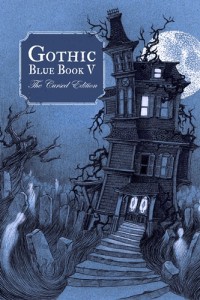

GOTHIC BLUE BOOK V: THE CURSED EDITION IS NOW AVAILABLE!

cover 333 500It’s here! GOTHIC BLUE BOOK V: THE CURSED EDITION!

First, I have to say I can’t believe this is our 5th book. When we started Burial Day Books 5 years ago we did it to give people a platform where they could share their traditional horror tales. Now, here we are, 5 years later and we have continued to grow. Each year we see more submissions and each year I get less and less sleep in reading your great stories, fighting with the Undertaker as to which story to publish, and of course formatting and editing the books.

I do admit, it’s gotten harder each year, but each time I step back and look at the finished product I’m so proud; I’m proud of our writers and I’m proud of myself that I can put this together so quickly. As many of you know, we take submissions, read them and publish the edition in less than a year’s time – a pretty fast turnaround for publishing.

We are excited to have a wonderful collection of poetry by Stephanie M. Wytovich, and fantastic fiction by Maria Alexander, Max Booth III, K. Trap Jones, Jennifer A. Smith, Kerry G.S. Lipp, and so many more.

Again, I’d like to thank our authors, and I especially want to thank all those that submitted and our supporters. I’m beyond thrilled that we’re still here after 5 years, and I’m thrilled that you all have continued to reach out to us, say hello, submit your stories, and enjoy our collections.

Print Edition

eBook Edition

Thank you so much.

Cynthia (cina) Pelayo
Gravedigger/Publisher
Burial Day Books


Gothic Blue Book V Featured Fiction Writer

maria-alexander-web2

Burial Day Books is honored to announce our featured fiction writer for GOTHIC BLUE BOOK V, Maria Alexander! Maria Alexander is a produced screenwriter, published games writer, virtual world designer, award-winning copywriter, interactive theatre designer, prolific fiction writer, snarkiologist and poet. Her stories have appeared in publications such as Chizine Magazine, Gothic.net and Paradox, as well as in acclaimed anthologies alongside legends such as David Morrell and Heather Graham.

Her debut novel, Mr. Wicker, won the 2014 Bram Stoker Award for Superior Achievement in a First Novel. Publisher’s Weekly called it, “(a) splendid, bittersweet ode to the ghosts of childhood,” while Library Journal hailed it in a Starred Review as “a horror novel to anticipate.” She’s represented by Alex Slater at Trident Media Group.

When she’s not wielding a katana at her local shinkendo dojo, she’s being outrageously spooky or writing Doctor Who filk. She lives in Los Angeles with two ungrateful cats, a pervasive sense of doom, and a purse called Trog.

Gothic Blue Book V Featured Poet

Stephanie M. Wytovich


Burial Day Books is honored to announce our featured poet for GOTHIC BLUE BOOK V, Stephanie M. Wytovich! Stephanie M. Wytovich is the Poetry Editor for Raw Dog Screaming Press, a book reviewer for Nameless Magazine, and a well-known coffee addict. She is a member of the Science Fiction Poetry Association, an active member of the Horror Writers Association, and a graduate of Seton Hill University’s MFA program for Writing Popular Fiction. Her Bram Stoker Award-nominated poetry collections, Hysteria: A Collection of Madness, Mourning Jewelry, and An Exorcism of Angels can be found at www.rawdogscreaming.com, and her debut novel, The Eighth, will be out in 2015 from Dark Regions Press. Follow Wytovich at stephaniewytovich.blogspot.com and on twitter @JustAfterSunset.

Happy Triskaidekaphobia Day!

ShanghaiMissingFloors

A picture taken in an elevator in a residential apartment block in Shanghai. Floors 0, 4, 13 and 14 are missing. Picture upload by Chrisobyrne at en.wikipedia

Fear of Friday the 13th is called Triskaidekaphobia. Many of us know that already. Many of us also know that the superstition has been attributed to a variety of events, the most famous of which is Christian in nature. It’s believed that Judas was the 13th person at the Last Supper and it is him who is said to have turned in Jesus of Nazareth in to the authorities. Now, the Bible makes no references to the number 13 in relation to this event. The Bible also makes no mention to the number 13 as being inherently evil, or unlucky.

There is information that references a fear of the number 13 before the Last Supper. The Babylonian Code of Hammurabi, one of the earliest deciphered forms of writing, which consists of 282 laws, is said to have no 13th law recorded. There is also information that attributes Loki, a deceitful god of Norse mythology, as being the 13th in that pantheon.

My interest with the fear of the number 13 has recently been structural in nature. You’ve probably been inside an elevator that does not provide you with an option for the 13th floor. I’ve been in buildings that do not have a 13th floor, and instead skip from 12 to 14. I have also seen buildings with an alternative designation to the 13th floor, such as 12A. It’s been said that some buildings close their 13th floor entirely  to the public using the space  instead for mechanical needs. Otis Elevator Company is the world’s largest manufacturers of vertical transportation, elevators and escalators. An article in USA Today stated that according to Otis Elevator Company 85% of elevator panels omit the number 13 entirely (http://traveltips.usatoday.com/isnt-there-13th-floor-hotels-107585.html).

When some people think of superstition and fear of the number 13, particularly Friday the 13th as being silly, just think of how many building designers have complied with their tenants wishes to eliminate the designation of the 13th floor entirely. I suppose many of us do believe the number 13 should be feared.

-Gravedigger

The Lucky Horseshoe

Horseshoe_and_devil.svg

“Horseshoe and devil” by Creator:George Cruikshank – The True Legend of St. Dunstan and the Devil by Edward G. Flight, 1871; image at http://www.gutenberg.org/files/13978/13978-h/13978-h.htm. Licensed under Public Domain via Wikimedia Commons


The other day I purchased a lucky horseshoe charm. Why? I don’t particularly know why other than I was compelled by the design. I have also heard of “Lucky Horseshoes,” but I suppose I didn’t know exactly why horseshoes are considered lucky. I suppose I purchased the charm because I somehow believed it would bring me good luck. This then compelled me to do some further research on Lucky Horseshoes.

A standard horseshoe is a constructed device fashioned out of metal that is intended to protect a horse’s hoof from wear. The most commonly used materials are steel and aluminum. The shoes are attached to the surface of the hooves, and are nailed through a part of the horse’s foot that is insensitive. Horseshoes can also be glued to the horse’s foot. A farrier is a person whose occupation is the fitting of these devices. The farrier‘s job is to assess the horse’s hoof, design appropriate shoes, and apply the product.

Now, it’s believed that the origin of the tradition of the lucky horseshoe originated with the story of Saint Dunstan and the Devil. Dunstan, who would later to become the Archbishop of Canterbury in AD 959, was a blacksmith. One day, the Devil asked him to reshoe his horse, and Dunstan nailed a horseshoe – through the Devil’s hoof, which caused the Devil much pain. Dunstan agreed to remove the horseshoe and release the Devil if the Devil promised to never enter a place where a horseshoe was hung over a door.

As there is a specific production and application involved in creating a horseshoe for wear, there is a specific placement of a horseshoe for use as a talisman in the home. First, some believe that a true lucky horseshoe should be found, not purchased. Then, the horseshoe should be hung above one’s entry door. It’s then believed that a horseshoe should be hung pointing upwards. The ‘U’ shape is thought to hold good luck that passes by. Hanging it upside down is believed to be bad luck, as it is thought all of the good luck will fall out. However, there are some who believe that the horseshoe should indeed be hung pointing downward, as it allows good luck to flow into the home.  To some, it does not matter how the horseshoe is hung (pointing upward or down), as long as it’s hung above the door because it’s presence alone is believed to draw good luck.

Do you have a horseshoe hung over your door? Is it pointed upward? Or, is it pointed downward. Let us know at @burialdaybooks on Twitter.

-Gravedigger

For Poe

Michael Tugendhat won the 2014 Dark Poetry Scholarship offered by the Horror Writers Association. His first book of horror poems is forthcoming (February 2015) from James Ward Kirk. He has had work appear or accepted for publication inMidnight Echo Magazine, Beyond Borderlands, Morpheus Tales #24 and elsewhere.


For Poe

By Michael Tugendhat


Ashore to find the autonomy of the word

should. As in, should I remove


the sciatica from the morsel of my condensation

my way of raining into the heart of a field.


Braying against the side of a pontoon boat, the twinning—

headstones of shore, your. Black sky where the pumpkins


of the cemetery have been spayed from their stems.

October rises, alive and under heaven.


Talk of sheep, swoons of a nearby sea.

C is the letter it all began with


Canopus of Carina, may shine your

heart out in the wine of the sky.


To mine come Poe, startle the sheen

and grease that comes with the fragment


`       of this Roman stone.


Monthly Submissions are Open & Showmen’s Rest


SLA01

It was a wild year end. We are excited to enter another year here at Burial Day and look forward to reading all of your tales. For those of you who have yet to receive a submission status for our monthly posting we will send you a status this week. Thank you for your patience, and yes, we are open for monthly submissions!

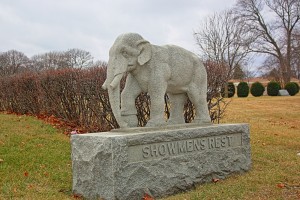
Last week, as we were recuperating from the madness of the holiday season we decided to take a drive to another cemetery, Woodlawn Cemetery in Forest Park, Illinois to specifically visit Showmen’s Rest. Large elephant statues flank the hundreds of markers commemorating their circus family. The elephants each have a foot resting on a ball, and their trunks are lowered in mourning.

What makes this Showmen’s Rest so sad is that it’s where dozens of performers are buried from one of the most tragic circus accidents in history. On June 22nd, 1918 over 56 employees of the Hagenbeck-Wallace Circus were killed when an engineer fell asleep and ran his train into the rear of the troop train. Many died from the impact of the crash. Many others died due to the fire that broke out after. There are legends of elephants racing to douse the firey trains with water, succumbing themselves to the fire. A few years prior, The Showmen’s League of America formed in 1913 with its first president Buffalo Bill Cody had purchased 750 burial spaces in Woodlawn Cemetery for its members. Many of the victims of the train accident were laid to rest there in a mass grave.

Many of the victims were unrecognizable and are commemorated on their graves simply as Unknown Male 15, Unknown Female 43, all the way up to Unknown Male 61. Some accounts say 56 people died in the accident, but an accurate casualty count is unavailable because of the fire.  There are a few stand out names, such as Baldy. One wonders if he were a clown or a driver. It’s said many of those who died were roustabouts, people who travelled with the circus putting up tents and performing various other jobs before disappearing at the end of the season. Most were known only by their nickname.

The Hagenbeck-Wallace Circus formed in 1907 in Peru, Indiana (now the site of the International Circus Hall of Fame) was the second largest circus besides Ringling Brothers and Barnum & Bailey.  The Hagenbeck-Wallace circus continued through to 1929 when it was sold to Ringling Bros.

There is plenty of folklore that surrounds Showmen’s Rest, primarily to do with the elephants. Some claim to hear the roar of elephants at night, but it’s said no elephants were buried at Showmen’s Rest. There is no official marker that indicates the Hagenbeck-Wallace disaster either at Woodlawn Cemetery or at the crash site in Indiana.

Other performers are buried at Showmen’s Rest. It’s a place of rest for other circus folk who have lived with the spirit that the show must go on.

Here are some pictures that we took at Showmen’s Rest. We hope you enjoy.

-Gravedigger

SLA06
SLA02 SLA03 SLA04 SLA05  SLA08 SLA09

GBB IV: THE FOLKLORE EDITION is now on Kindle

GBB4_267x400

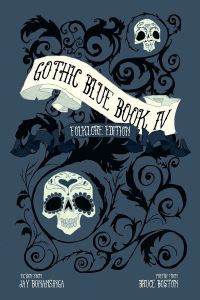
GOTHIC BLUE BOOK IV: THE FOLKLORE EDITION is now available on Kindle! Featuring new fiction by New York Times bestselling author JayBonansinga, author of the Walking Dead novels, and Bram Stoker and Pushcart Prize winning author Bruce Boston! The print edition is to follow.

Gothic Blue Book IV: Folklore Edition Cover

Presenting this years’ cover for the Gothic Blue Book drawn by Abigail Larson, featuring poet Bruce Boston and Jay Bonansinga, co-author of The Walking Dead.

GBB4

Jack the Ripper “Unmasked”

JacktheRipper1888


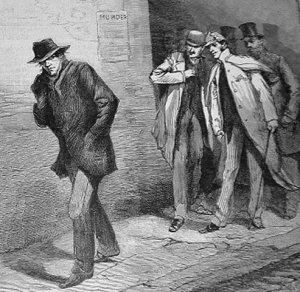
Jack the Ripper’s identity may finally be revealed, bringing a new level of horror to the story.

I should preface by saying that my attitude toward the recent mitochondrial DNA evidence is one of cautious optimism. Disregarding for the moment that the evidence has yet to undergo peer review, it’s a bit shocking to have a face and name for what was, for over 125 years, an unfathomable monster. Aaron Kosminski may be the name, the face of whom is a mentally ill survivor of yet another type of horrific violence: the pogroms of Tsarist Russia (which included modern-day Poland).

“Pogrom” is another word for a massacre; it’s like a riot that erupts in violence that targets a specific ethnic or religious group. In Kosminski’s homeland, anti-Semitic demonstrations and mass murders took place throughout most of the 1800s; Kosminski and his family were impoverished Jews who fled in the 1880s to Whitechapel, London.

This was less than a decade before Jack the Ripper terrorized Whitechapel, which was, at that time, a slum. Its population consisted mostly of Irish and Jewish immigrants, who were deemed the lowest of the low in Victorian England, possibly lower than the 1200 prostitutes who worked Whitechapel’s streets. What I’m saying is, Kosminski may have led the most pathetic life imaginable in post-Medieval Europe.

Man, the more we find out about this guy, the more of that sexy edge we lose from the story of Jack the Ripper. Kosminski was a refugee, with stints in mental hospitals, and, according to testimony from his day, had a history of “self-abuse” (the 19th century euphemism for jerking his chicken, or stroking his bishop, or masturbating at every opportunity even if it involved horrified onlookers). I’m starting to understand why this guy was a chief suspect for over a century.

The DNA evidence, by the way, was in the form of ejaculate found on a shawl belonging to one of the Ripper’s final victims. So even if a match is confirmed, there will always be detractors who say that Kisminski’s DNA could have ended up on Catharine Eddoews’ shawl due to circumstances unrelated to her murder. After all, the man apparently had a habit of leaving his semen in every corner of Whitechapel. He and Eddowes may have even had consensual sex hours before she died.

What this news story brings us, however, is not the possibility of a resolution to one of the world’s most famous cold cases; it is just another piece of the puzzle that is the human mind.

Kosminski was a mentally troubled person (to say the least), targeted in his homeland with anti-semitic violence, which likely exacerbated his issues. He lived in a time when the mental health industry was not remotely a thing. There were no psychologists or therapists or counselors; if you were weird, they locked you in a building far away, whether you were an epileptic or liked to fingerpaint with your own feces.

So the horror of the Jack the Ripper story has not diminished, but the nature of it has changed. Now, instead of a faceless demon, Jack the Ripper represents the evil within the mind, kept in check only by mental processes that are immeasurable and unquantifiable; an evil that is unleashed and fed by nonsensical violence in perpetuity.

Jack the Ripper’s story will never be over. He was not a man, but the personification of human psychosis. And he’s still out there.


BIO

M. N. Hanson has been published previously in Vine Leaves, Burningword, Revolver, and Gothic Blue Books I & II. M is a student of the absurd bordering on the grotesque. Favorite word: Diapsalmata. Second favorite word: Ithyphallophobia. Please visit http://mnhanson.com to complain.